


Last updated: August 2026 · Actively maintained
TL;DR
This is a vibe coding resource hub for AI builders who want to ship real products, not just impressive demos. It collects 18+ practitioner-tested guides across vibe coding, spec-driven development, PRDs, debugging, cybersecurity, prompt systems, code blocks, and tool selection across Claude, Cursor, Lovable, Gemini, Replit, and v0.dev. Start with the reading path that matches what you are trying to build. Free readers get the map. Paid members get the build materials: prompts, code blocks, PRD templates, failure logs, and project structures behind the guides.

Every vibe coding guide teaches you how to generate an app.
This hub teaches you how to build one you can debug, secure, explain, ship and stand behind.
Pretty screens are cheap now. Judgment is not.
This vibe coding resource hub collects the guides, tools, prompts, workflows, and safety practices you need to build software with AI coding agents using natural language.
It treats vibe coding as product discipline: choosing the right tool, writing better specs and PRDs, debugging AI-generated code, securing apps before production, and shipping features that survive contact with real users.
I organized the hub as questions and answers.
Pick your goal and follow the reading path that fits where you are today.

Who This Hub Is For
Do I need coding experience to use this hub?
No.
You don’t need coding experience or technical background to use this hub. Curiosity is enough.
I’ve watched members with zero technical background automate their workflows, build systems and ship apps that save them and their teams hours per week.
One member described the shift better than I could:
I don’t even remember why I subscribed to Karo, probably an algorithm nudge. For weeks I just read her emails about learning AI by using and building with it.
Once I finally tried, a whole NEW WORLD opened: I built a collaboration and content pipeline for my team, became “THE AI person” at work, and I’m still shocked by what I can do now.

Hey, I’m Karo Zieminski 🤗
AI Product Manager and builder.
I write Product with Attitude, an AI newsletter for thousands of subscribers developing critical AI literacy the only way it sticks: through practice.
We don’t just use AI. We build workflows, automations, and products with it, while studying how AI itself is built, positioned, and woven into our work.
If you’re new here, welcome! Here’s what you might have missed:

Start here:
Pick Your Goal, Then Follow the Reading Path
If You’re New to Vibe Coding
If You’re Choosing Tools or Workflows
If You’re Preparing to Build
If You’re Debugging or Shipping
If You’ve Already Built Something
Best Vibe Coding Resources by Builder Goal
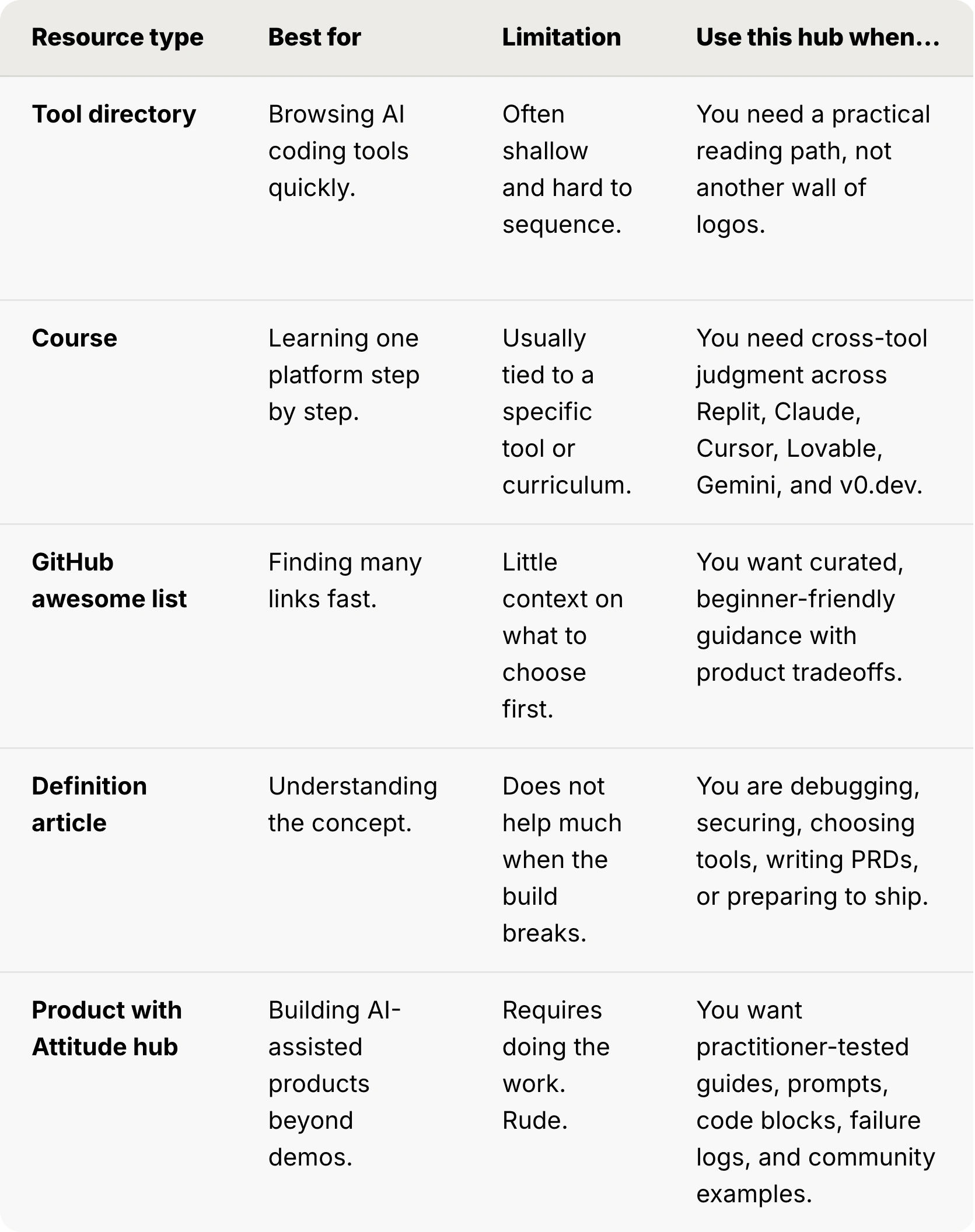
Tool directories, courses, GitHub lists, and definition articles are useful. They also leave a lot of “okay, but what do I do now?” hanging in the air. This hub is a field guide for turning AI-assisted development from scattered advice into repeatable product-building practice.
Resource Type Comparison Table
Foundations: What Vibe Coding Is
What is vibe coding?
Vibe coding is prompt-led software development: a way of building software by describing desired outcomes to an AI coding assistant, then testing, revising, and reviewing the generated code through an iterative conversation.
Vibe coding makes software creation more accessible by replacing some manual coding with natural language prompting. Its strength is speed. Its weakness is reliability. The best results come when vibe coding is paired with testing, version control, security review, and human product judgment.
Read the full 2026 guide:
So, Are You Really Vibe Coding? The 2026 Definition, Lexicon, and Decision Framework

This article defines a new AI development lexicon, categorizing methodologies into "Vibe Coding" (prompt-led), "Spec-Driven Development" (PRD-driven), and "AI-Assisted Engineering" (human-disciplined). The framework aims to clarify how builders interact with autonomous agents, including a "Pre-Build Interrogation Prompt".
Where did the term “vibe coding” come from?
The term vibe coding was coined by Andrej Karpathy in early 2025 to describe a highly conversational way of building software with AI. Instead of manually writing every line of code, the user explains what they want, reviews the result, and keeps prompting until the software behaves as intended.
I want a complete, end‑to‑end guide to vibe coding
Read The Ultimate Vibe Coding Guide From Builders Who’ve Shipped.
It’s a 16-step practitioner playbook covering the full arc from concept to shipped product.
What is vibe coding as a product-building discipline?
Vibe coding is the practice of building software by describing your desired outcome in natural language and iterating with AI until the product is ready.
The hard part is judgment. Knowing what to accept, what to reject, and when the AI is confidently wrong.
I built a dedicated interview series around that craft layer: the quality bar, the architectural calls, and the decisions that separate a shipped product from a shipped demo.
As a product-building discipline, it combines AI-generated code with human judgment, architectural thinking, engineering principles, and deliberate review.
The beginner mistake is treating a working screen as a working product. A product also needs requirements, authentication, data rules, edge-case handling, debugging, security checks, and a user who can break it in ways the demo never did.
Do I need to know how to program to vibe code?
No.
Vibe coding lowers the barrier to software creation because we can build with natural language prompts instead of traditional syntax.
This makes it useful for non-programmers who want to create prototypes, internal tools, scripts, landing pages, or simple applications.
However, the less code you understand, the more important it becomes to test, review, and verify the output. Vibe coding can help you build faster. It does not automatically make the result safe, scalable, or correct.
How is vibe coding different from traditional programming?
Traditional programming is code-first software development. Vibe coding is prompt-led software development.
How does vibe coding work?
Vibe coding usually follows an iterative loop:
Describe the outcome you want.
Let the AI generate the first version.
Test the result.
Describe what is broken, missing, or wrong.
Ask the AI to revise the code.
Repeat until the product works well enough to ship, test, or discard.
The strongest vibe coding workflows are structured conversations with the AI, guided by product judgment, testing, and clear constraints.
Can vibe coding be used for professional apps?
Yes.
Vibe coding can be used to build prototypes, MVPs, internal tools, automations, landing pages, and commercial software.
For professional applications, vibe coding works best when paired with engineering review, version control, testing, security checks, and clear product requirements. Larger companies usually need additional controls because AI-generated code must fit existing systems, compliance rules, architecture standards, and release processes.
Is vibe coding a real job now?
Not really. The valuable skill is AI-assisted product building: translating messy needs into clear specs, reviewing AI outputs, debugging, securing, and shipping.
Methods: Vibe Coding vs Spec-Driven Development
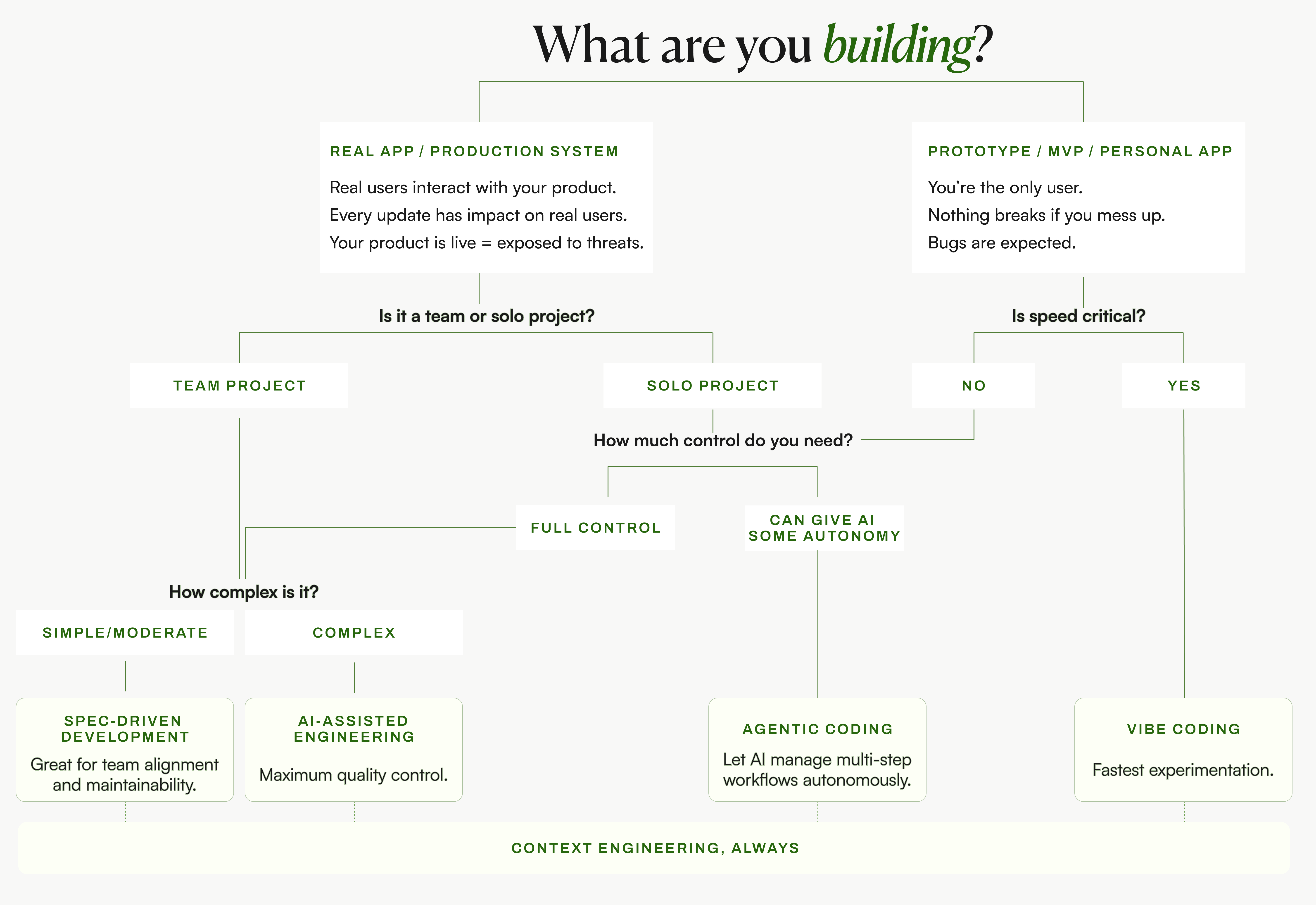
Which AI‑assisted coding method is best for me?
If you’re not sure which method fits you best, or want to understand the terminology before choosing a workflow - this will help:
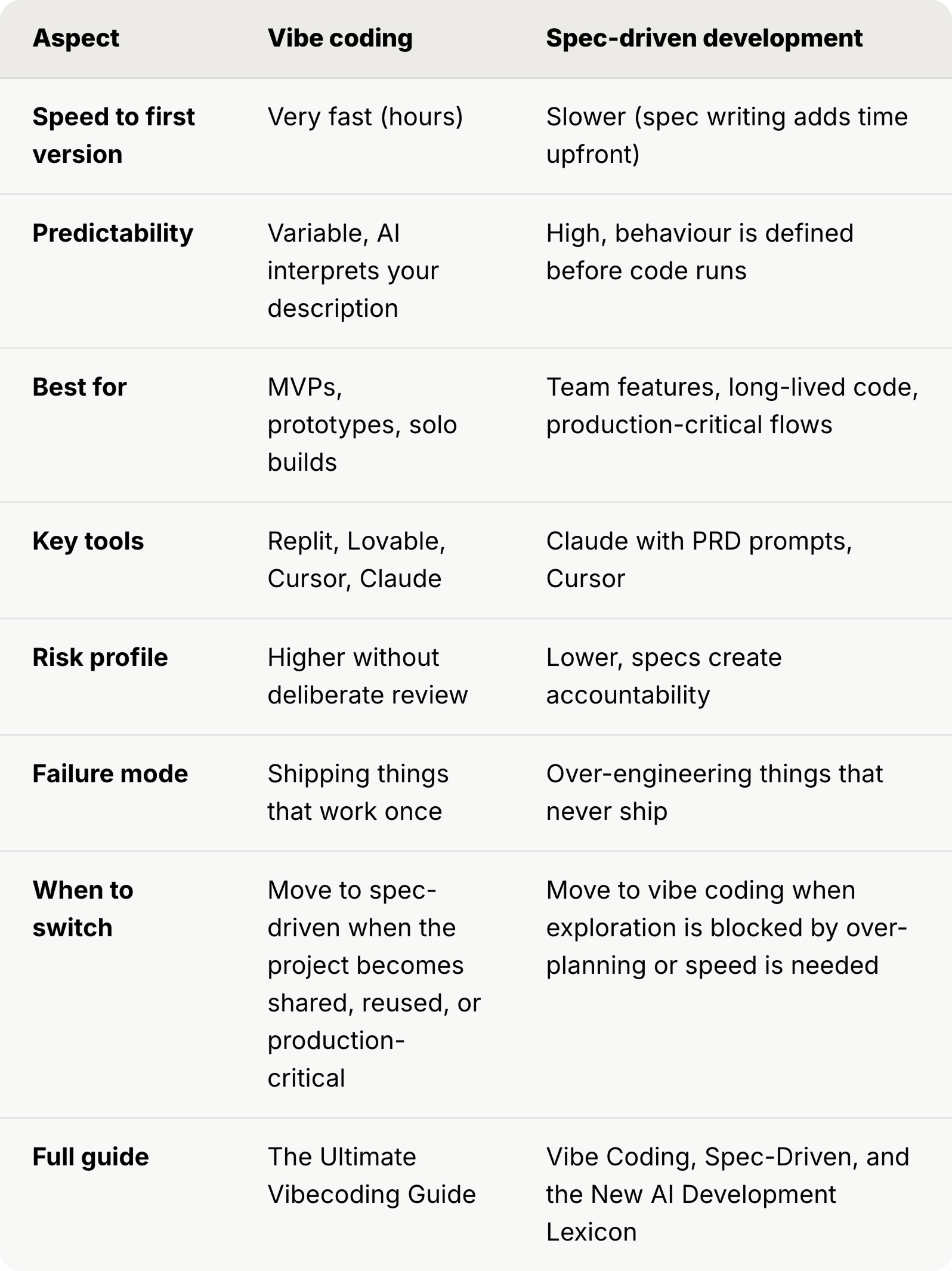
What’s the difference between vibe coding and spec-driven development?
Vibe coding and spec-driven development sit at opposite ends of AI-assisted software engineering: vibe coding optimizes for rapid prototyping through conversational iteration, while spec-driven development optimizes for maintainability, reproducibility, and governance through formal requirements that guide AI-generated code before implementation starts.
Technical Concepts
What Is Context Engineering?
Context engineering is the practice of giving an AI system the right information, constraints, examples, tools, memory, and rules before asking it to do the work.

What is Prompt Engineering?
Prompt engineering is the practice of writing clear instructions that help an AI system produce a better answer, output, or action.

What is AI Agent Management?
AI agent management is the practice of directing, supervising, testing, and controlling AI agents as they perform multi-step work.

What is an IDE?
An IDE, or Integrated Development Environment, is the software workspace where builders write, edit, run, debug, and manage code. In vibe coding, an IDE often becomes the place where a human and an AI coding assistant work together to build, test, and fix a project.
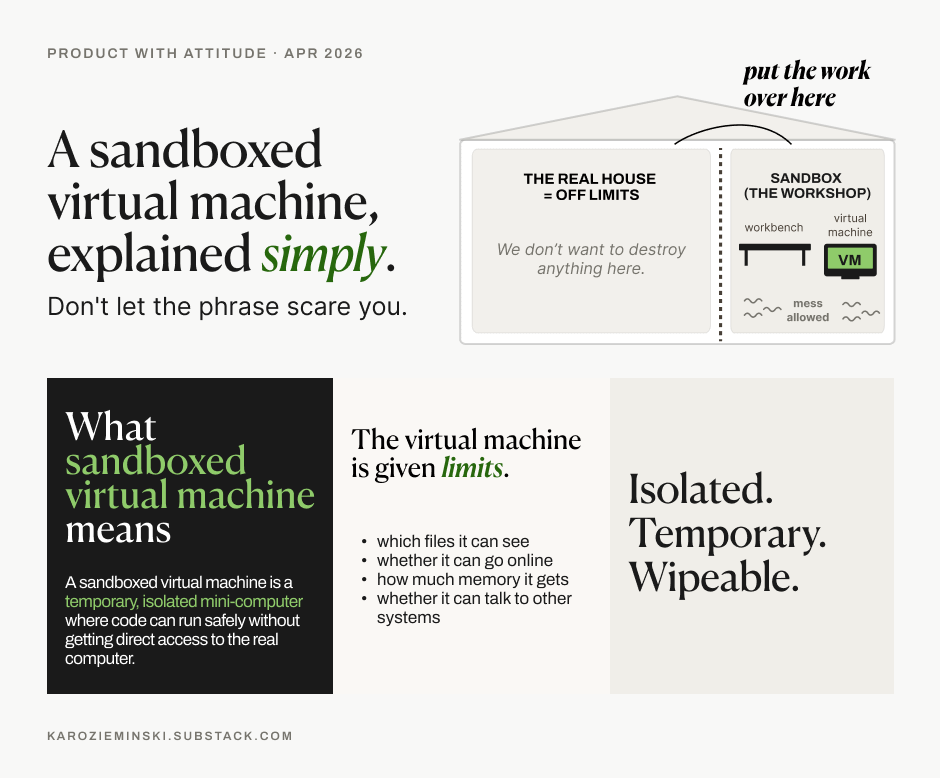
What Is A Sandboxed Virtual Machine?
In this article, I explain the concept of a sandboxed virtual machine: visually, without jargon, and for beginners.

Tools:
Choosing the Right Vibe Coding Stack
What tools do people use for vibe coding?
Common vibe coding tools include AI coding assistants, AI-native development environments, and conversational coding agents. Some examples:
Lovable
Claude
Replit
Gemini
Cursor
v0.dev
I use these tools differently depending on whether I’m prototyping UI, debugging production issues, writing specs, testing architecture, or trying to figure out why the app is buggy.
The tool matters less than the workflow. Good vibe coding depends on clear prompts, small tasks, visible tests, and human review.
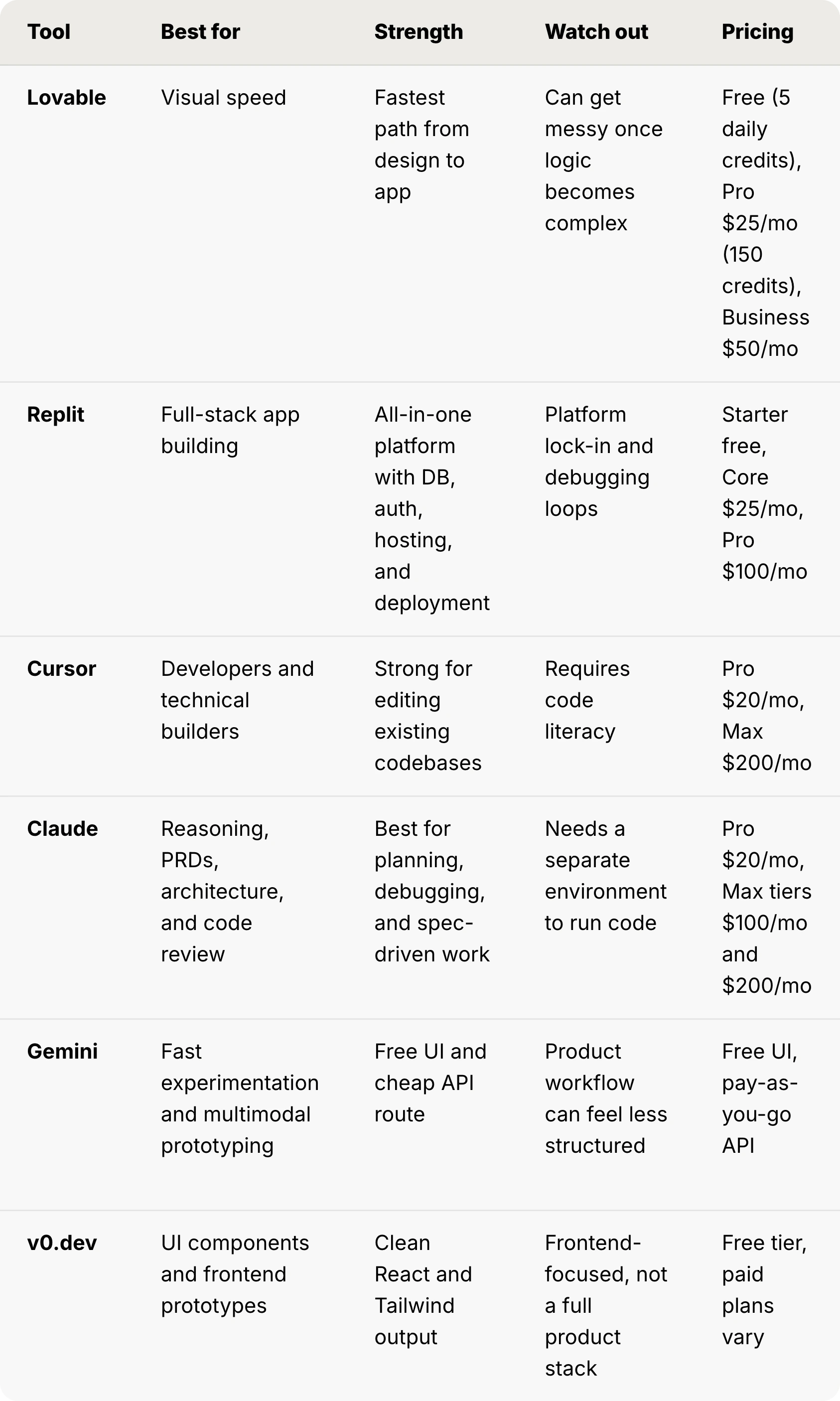
Which vibe coding tool is best for me in 2026?
A good vibe coding tool should match the way you think, the product you are building, and the amount of control you need. Replit, Cursor, Claude, Lovable, Gemini, and v0.dev can all be useful. They are not useful for the same reasons.

What is the best free vibe coding IDE?
Replit, Cursor, VS Code with AI extensions, and Google AI Studio or Gemini-based workflows can all work. The right choice depends on skill level, stack, deployment needs, and whether you want a browser workspace, local editor, or AI-first app builder.
What is the best database for vibe coding?
The best database depends on the app.
Supabase or Firebase can work well for many beginner full-stack apps, hosted Postgres gives more control, and sometimes the correct database is no database yet because the product doesn’t need persistence. Future you will appreciate that restraint.
Where should I deploy a vibe-coded project if I’m choosing between Netlify, Vercel, Railway, and Supabase?
Don’t pick the platform first. Pick based on what your project needs. I wrote a practical decision tree for exactly this here:

Build Better:
PRDs, Prompt Systems, UI Prompts, and Code Blocks
Where can I find proven prompts for UI elements when I’m vibe coding?
Read 100 Most Common UI Elements For Vibe Coders.
It’s a practical reference of 100 UI components vibe coders regularly design, prompt, and ship, organized by type and use case. It’s best for builders working on frontend features and product interfaces.
How can I write better PRDs when I’m vibe coding so they catch problems early?
Use the guide Vibe Coding, But Smarter: The PRD Prompt That Audits Itself
It gives you a PRD Builder Prompt with built‑in self‑auditing for hallucinations and failure modes, so your requirements catch problems before the code does.
It’s best for vibe coders defining and validating product requirements before building.
How do I write rules for AI that work across Replit, Cursor, Lovable and Gemini?
Read Rules-For-AI Generator: A Beginner-Friendly System.
In this article, I share a custom generator system that helps your coding agent with product judgement.
Where can I find ready‑made code blocks?
Source Code: The Runaway Subscribe Button
The exact code running on productwithattitude.com, packaged so you can drop it on any site in under five minutes.

Valentine’s App 2026: Full Source Code
Full React source for the 2026 Valentine’s scratch card app. Annotated for readability.

Ship Safely:
Debugging, Cybersecurity, and Production
Is vibe coding risky?
Yes, if we ship generated code without review, security checks, authentication sanity, database rules, and failure testing. The risk is that the code looks finished before the product has been inspected.
Is vibe coding a trap?
It becomes a trap when we confuse a working demo with a reliable product. The way out is spec-driven development, review, testing, and shipping discipline. Very boring. Very useful.
How do I secure vibe-coded apps?
How do I ship vibe-coded products to production safely? What are the biggest security risks in vibe-coded apps?
Shipping to production is a different discipline than prototyping. The things that break when real users show up (security vulnerabilities, auth failures, looping agents, environment-specific edge cases) don’t surface during demos.
Every guide below is built from real product failures, not hypotheticals:
Vibe Coding x Cybersecurity: The 2026 Builder Survival Guide
It covers the seven most common security vulnerabilities in vibe-coded products, with a decision matrix for responsible shipping. AI-generated code passes syntax checks and fails security ones. Read before you launch, not after.Is Your Replit Looping? This Will Help.
Covers how to diagnose looping behavior, context failures, and runaway agents. Includes specific prompts to stop the loop and recover the session. Best if you’re stuck in a debug spiral right now.
Real-World Tool Experience: Replit, Claude, and Perplexity
Claude and Perplexity live in dedicated knowledge hubs. Replit gets two failure-driven guides based on real product problems.


As for Replit, start with these two guides that came out of real product failures:
After You’ve Built
Feedback and beta testers
If you’re looking for beta testers or product feedback, feel free to DM me. I’ve already helped many builders find early testers, get useful feedback, and put their products in front of the right people. I can do the same for you. I read every message.
Showcase on Product with Attitude
Congrats on the build! Drop it in our Wednesday Build Board. That’s when community members share their latest projects. I feature the best ones in showcase articles like What AI Builders Are Shipping in the PwA Community Right Now.
Showcase on StackShelf
Add it to StackShelf.app. It’s an LLM-optimized showcase built for Substack creators. Your build becomes discoverable by AI search engines and the broader community.
Paid members get priority features in showcase articles and builder spotlights.
Community chat
If you’re looking to connect with other builders, our Community Chat is the best place to start.

References and Further Reading
These are useful external resources. I’m including them because they help map the broader vibe coding ecosystem.
DeepLearning.AI: Vibe Coding 101 with Replit. A strong Replit-based course for agentic development, with a useful reminder that vibe coding is not one-shot prompting. Great for Replit, less complete across Claude, Cursor, Lovable, Gemini, PRDs, security, and community shipping.
Figma: 10 Vibe Coding Tools for Building Better Experiences. A useful tool comparison for product and design teams choosing among modern AI coding tools. It helps you compare, not necessarily ship responsibly.
GitHub: awesome-vibe-coding. A broad open-source list of vibe coding references and tools.
Vibe Coding Learn: Vibe Coding Resource Hub. A concise resource category page with beginner-friendly framing. Useful, but generic. It doesn’t carry the same practitioner-tested shipping context.
Subscribe So You Don’t Miss Updates

WHY SUBSCRIBE ・YOUR BENEFITS・ TOOLS I BUILT・CLAUDE HUB・PERPLEXITY HUB ・VIBE CODING HUB