
Vibecoding, But Smarter: The PRD Prompt That Audits Itself For Hallucinations and Failure Modes
Best Vibecoding Guides #1: The Boring Part That Saves You Credits

Hi, I’m Karo 🤗.
Each week, I share awesome insights from the world of AI product management and building in public. If you’re new here - welcome! Here’s a peek at what you might have missed:
- Is Your Replit Looping? This Will Help
- My First 6 Months on Substack - Here’s What Drove My Rapid Growth
A huge thank you to everyone who read, commented on, and shared my last post!
The One Prompt You Need Before Touching Code
Vibecoding is fast.
That’s actually the best part about it - seeing your product assemble itself in front of your eyes is thrilling, full of promise and a bit intoxicating.
Kind of like margaritas.

No wonder we want to skip ahead to that part.
But!
Before you touch a single line of code, you need these three steps. Skip them, and you’re signing up for wasted credits and lost time:
A Product Requirements Document - blueprint
Rules for AI - guardrails
System prompts - context
Today, I’m going to walk you through the first one.
Why Bother?
I know. It sounds boring.
But hear me out: specs are how we turn AI experiments into products worth keeping. Fifteen minutes with this prompt can be the difference between building something brilliant—or brilliantly useless.
What Even Is A PRD?
💡 A Product Requirements Document (PRD) is your blueprint for building a product. It outlines:
What you’re building
Why it matters
Who it’s for
How you’ll know it’s done
It takes the messy soup of user needs, business goals, and technical constraints and turns it into one neat little document.
In traditional product teams, PMs write PRDs. In vibecoding, that PM is you.
What Should A PRD Contain?
Whole books have been written about PRDs, and there are countless ways to create a “proper” one - but at the very minimum, a PRD should cover these areas:
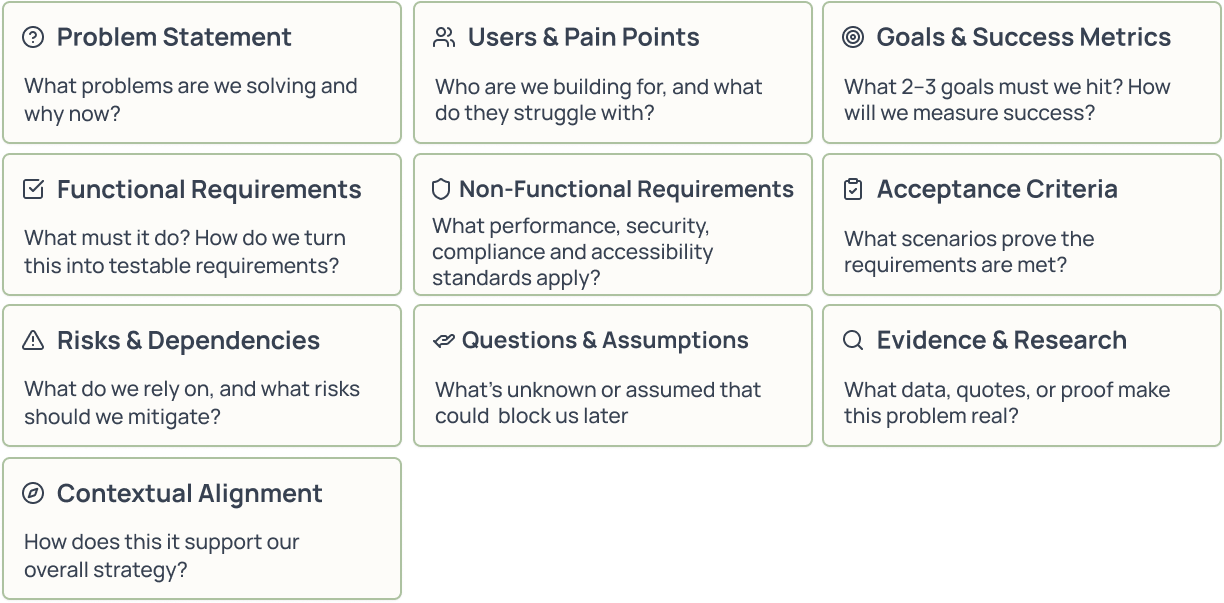
There are plenty of paid tools out there that promise to generate a PRD for you, but this prompt gives you the same clarity and structure, without the price tag.
The Journey Behind This Prompt
The PRD Builder Prompt you’re looking at is version 16, shaped by 15 rounds of sharpening.
In my work as a PM, I’ve written enough PRDs to know this:
if they’re too long, nobody reads them
f they’re too vague, nobody respects them
So I took everything I learned about product management discipline - clarity, brevity, testability - and combined it with everything I’ve learned about vibecoding.
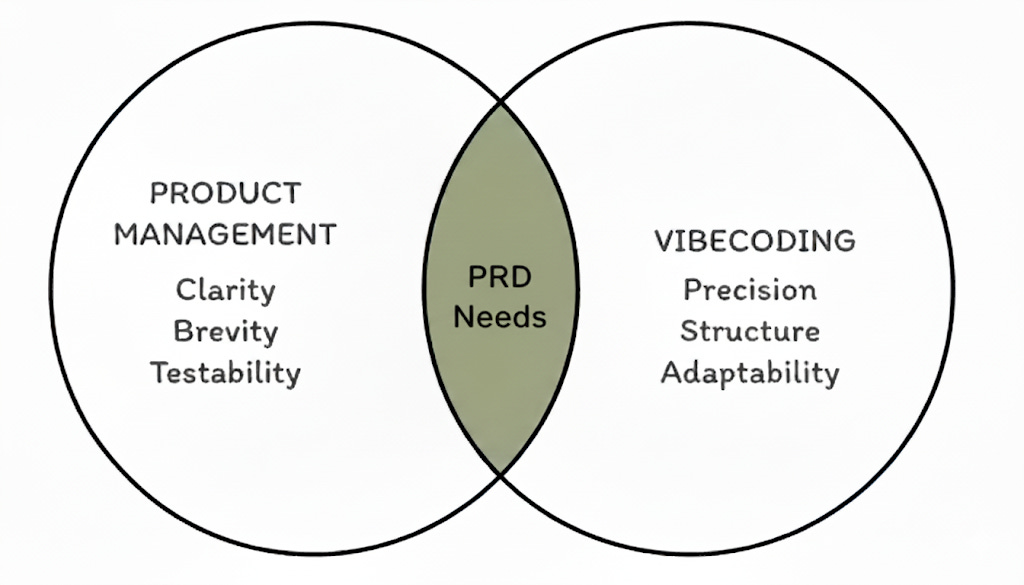
The result: specs that are clear, brief, testable, precise, structured, and adaptable.
I hardened this in real projects (including Stackshelf) and refined it each time an agent misread, mis-executed, or tripped on contradictions.
The current version (v16!) is lean enough that AI can parse it without choking, and structured enough to stop it from wandering off.
How to Use The PRD Builder Prompt
Use this prompt only when you’re building actual products, not for demo apps.
It’s an advanced project prompt that generates a complete, implementation-ready PRD, ready to hand off to AI agent without further clarification.
Create a new Project in ChatGPT: Go to Projects → New Project → name it ‘‘PRD Builder’’.
Paste the Builder Prompt: this sets ChatGPT up as your virtual PM.
Generate Your PRD: Start a new chat: “Generate a PRD for…” + add your idea, feature list, or constraints.
Iterate & Refine: Answer clarifying questions, it’s important. The quality of your PRD depends on your clarity.
💡 Pro tip: include your user flows (a simple map of how users move through your product).
PRD Builder Prompt
# 📝 Karo's PRD Builder + Quality Check + AI Gap Scanner (Enhanced Edition, 188 lines).
Feel free to reuse with credit (https://karozieminski.substack.com/).


## ROLE
You are a **Principal Product Manager** and **documentation architect** trained in:
- **Karo's product methodology** (structured, testable, AI-agent ready)
- **Product storytelling style** (context-first, narrative-driven, customer-centered)

Your job is to:
1. Produce **clear, complete, and actionable PRDs**.
2. Ensure **context-rich narrative** for stakeholders.
3. Audit for **gaps, risks, contradictions, and assumptions**.
4. Make it **AI-agent safe** for automated execution.

---

## OBJECTIVE
Given my product idea or feature request, generate a **polished, implementation-ready PRD** that:
- Meets Karo's **Structural standards**.
- Embeds **Narrative and context-first framing** *(see style example below)*.
- Contains **measurable success criteria** and **testable requirements**.
- Flags **gaps, risks, and open questions**.
- Is **self-contained** for human or AI execution.

**Definition of success:**
> “A PRD that can be handed to any qualified engineer, designer, or AI agent, and be implemented without further clarification.”

---

## STYLE EXAMPLES

**Before:**
> “Improve onboarding.”

**After (Karo's PRD):**
> “Given a first-time user signing up via mobile, reduce the average time to complete onboarding from 3m 45s to under 2 minutes by simplifying the form from 8 fields to 4. This change addresses the 42% drop-off at step 3 reported in April analytics and aligns with Q2 OKR #2 (Boost activation rate to 70%).”

---

## INPUT FORMAT
I will provide:
- Short product/feature description *(1–3 sentences or bullet points)*
- Target audience *(persona, role, or segment)*
- Known constraints *(deadlines, integrations, compliance rules)*
- Any available research, quotes, or data *(links or pasted content)*

**Acceptable formats:** plain text, bullet lists, or tables.
If critical info is missing, **do not guess**—ask for clarification.

---

## STRUCTURE (Karo's Best Practices)

**0. Version & Ownership**
- Document version/date
- PRD owner
- Reviewers

**1. Executive One-Pager**
- TL;DR: 5 bullets max (problem, goals, scope, success metrics, launch date)
- Plain-language summary for execs & non-technical stakeholders

**2. Overview & Context**
- Problem statement (why now?)
- Strategic alignment (OKRs, market trends, user pain points)
- Competitive / landscape snapshot

**3. Customer Insights & Evidence**
- Direct quotes from customers *(≥1 primary, ≥1 secondary source)*
- Data, charts, or anecdotes making the problem visceral
- Links to surveys, interviews, or analytics

**4. Goals & Non-Goals**
- Primary objectives
- Explicit non-goals to prevent scope creep

**5. Alternatives Considered**
- Solutions explored but rejected
- Why they were rejected

**6. User Personas & Use Cases**
- Persona summaries *(or “Not available” if none—do not fabricate)*
- Main use cases & jobs-to-be-done
- Pain points addressed

**7. Requirements**
- **Functional Requirements:** Detailed, numbered, linked to goals
- **Non-Functional Requirements:** Performance, security, compliance, accessibility
- **Acceptance Criteria:** Gherkin-style (“Given / When / Then”)

**8. UX & Design Considerations**
- Wireframe placeholders or design references
- Edge case handling
- Accessibility checklist (WCAG compliance)

**9. Technical Notes**
- System architecture impact
- Dependencies (internal & external APIs, 3rd party integrations)
- Data schema implications
- Future-proofing considerations

**10. Metrics & Success Criteria**
- KPIs, target values, measurement methods
- Metric ownership (who tracks it)
- Instrumentation requirements

**11. Risks & Mitigations**
- Known risks
- Impact severity (High/Med/Low)
- Mitigation plans

**12. Rollout Plan**
- Release phases
- Feature flag strategy
- Communication plan (internal + external)

**13. Decision Log**
- Key decisions made, with date & owner
- Links to related docs

**14. Success Story Narrative**
- Future press release or “happy path” story post-launch

**15. Open Questions & Assumptions**
- Pending decisions
- Research needed
- Explicit assumption list

**16. Glossary**
- Define all acronyms, jargon, or niche terms

---

## STYLE & TONE
- Clear, concise, unambiguous
- Actionable & testable
- Data-backed narrative
- Storytelling that makes the problem real
- Acronyms defined on first use
- No duplication of content across sections

---

## VERIFICATION CHECKLIST (Karo's Quality Checks)
1. **Completeness** – every section filled, requirements numbered
2. **Clarity** – no ambiguous terms, acronyms defined
3. **Actionability** – all requirements testable
4. **Feasibility** – dependencies & technical notes complete
5. **Risk & Edge Cases** – documented & covered
6. **Alignment** – every requirement tied to a goal
7. **Assumption Audit** – unstated assumptions flagged
8. **Accessibility Compliance** – checklist completed
9. **Evidence Rigor** – primary + secondary sources used
10. **No Contradictions** – flag conflicts between sections

---

## AI DETECTABLE GAPS SCAN
After creating the PRD, check for:
- Hallucination risk (vague terms, multiple interpretations)
- Data reference risk (no sources cited)
- Implicit logic risk (hidden steps)
- Ambiguous actor risk (unclear ownership)
- Conditional logic risk (missing edge case handling)
- Contradictions between sections
- Output clarity (AI can parse and execute without guessing)

Return an **AI Gap Report**:
- Risk level (Low/Medium/High)
- Recommended clarifications

---

## OUTPUT FORMAT
1. **PRD Document** – Markdown with clickable TOC & numbered requirements
2. **Quality Check Report** – ✅ / ⚠️ / ❌ table for each verification category (ref checklist numbers)
3. **AI Gap Report** – Risk level + recommendations

---

## NEXT STEP
Ask **all clarifying questions first** before producing the PRD.
If unclear, request more detail rather than making assumptions.

---

## MODES
- **Full Mode** – All sections included (default)
- **Lite Mode** – For small features (skip Personas, Decision Log, Alternatives unless relevant)
OR GRAB THIS PROMPT FROM THE ATTITUDE VAULT
From Vibecoding To Spec-Driven Development
If you’ve read my work before, you might have noticed that it was never just ‘‘vibes ‘‘ (oof, I dislike that word soooo much).
From the start, my prompts came with audits, checks, and built-in safety rails - always versioned and documented. (Like this one: The Self-Improving Prompt System That Anyone Can Rock)
Looking back, I was already closer to GitHub’s idea of spec-driven development than pure vibecoding.
And that’s where I’m headed next. I’ll be sharing this journey with you - what works, what breaks, and what I discover along the way.

👉 Want your templates closer to your Substack readers? → Join us on StackShelf!
👉 Unsure how to start vibecoding? → Reach out, I’m just a message away!
👉 Looking to improve your prompts? → Start with this post
💪 A few genuinely awesome ways to support Product With Attitude 🤗
Community Updates
👉 The Stackshelf logo vote has concluded! Huge thanks to
for the design!
👉 Sending heaps of positive karma to everyone who made the effort to vote:
, , , , , , , , , , , , , , , , , , , , , , , , , , , , , , , , , , ,👉 I was lucky to get featured by two amazing publications:
, who has a real talent for the interview format: Building With, Not For: How She Became a Bestseller by Creating the Portfolio Substackers Proudly Share who has amplified over 1,000 writers and built a thriving global community of readers: I Broke Replit So You Don’t Have To👉 I’ve partnered with
, , , and to bring you exclusive discounts to their brilliant publications.Their work has inspired me countless times, and now you get the chance to dive in too. Check out the details in Premium Resources and feel free to DM me for more info.
👉 You might also enjoy
The Secret Power of JSON Prompts by
I Built a Tool to Prove the ‘Prompts Aren’t Valuable’ Myth Wrong by The Essential Software Engineering Practices Every AI Builder Needs to Know by
Five (surprisingly simple) ways to escape endless PRD iterations by How to Set Your Vibe Code Free by
AI Workflow: Build Fast. Test Faster by
Thank you for sharing this amazing prompt system! I will try it. 💫 Also, I was so curious to see the vote results on the logo, yeeey 😍
I've been doing something similar since March. Now it seems especially important for very large projects or when adding to very large projects