

Perplexity Hub
Tested guides, credit strategies, and workflows for Perplexity Computer, Comet, and Labs. Last updated: March 2026.

Last updated: March 2026
TL;DR
Perplexity Hub is an independent library of tested guides for Perplexity Search, Files & Apps, Comet, and Computer, focused on real workflows, credit strategy, and SEO/AIO/GEO use cases. It helps builders, writers, and PMs decide which Perplexity product to use, shows what you can ship with each, and documents where credits disappear and where the “wow” lives.

I wrote my first Perplexity article in October 2025, not that long ago when you think about it.
Since then, Perplexity has shipped Comet, Computer, Comet Plus for publishers, Personal Computer, mobile apps, and become a tool I reach for daily.
To bring the most value to my readers, I’ve been pushing it to its limits, breaking things on purpose, and wearing different hats in the process: testing it as a builder, product manager, writer, and beginner.
This page collects everything I’ve published about Perplexity on Product with Attitude.
Guides, credit strategies, workflow breakdowns, product manager’s commentary, competitive landscape analysis, and posts where Perplexity plays a supporting role alongside Claude, Replit, and the rest.
A few things I want to make clear:
Every guide is tested on real projects.
Every credit estimate comes from my own usage (learned the expensive way on at least two occasions).
Every infographic you see started as a Miro board full of scattered thoughts.
Nothing theoretical. I don’t skip the parts that don’t go as planned, and if you keep reading, neither will you.


New to Perplexity? Start with the “What is Perplexity?” section right below.
What is Perplexity and which product do you need?
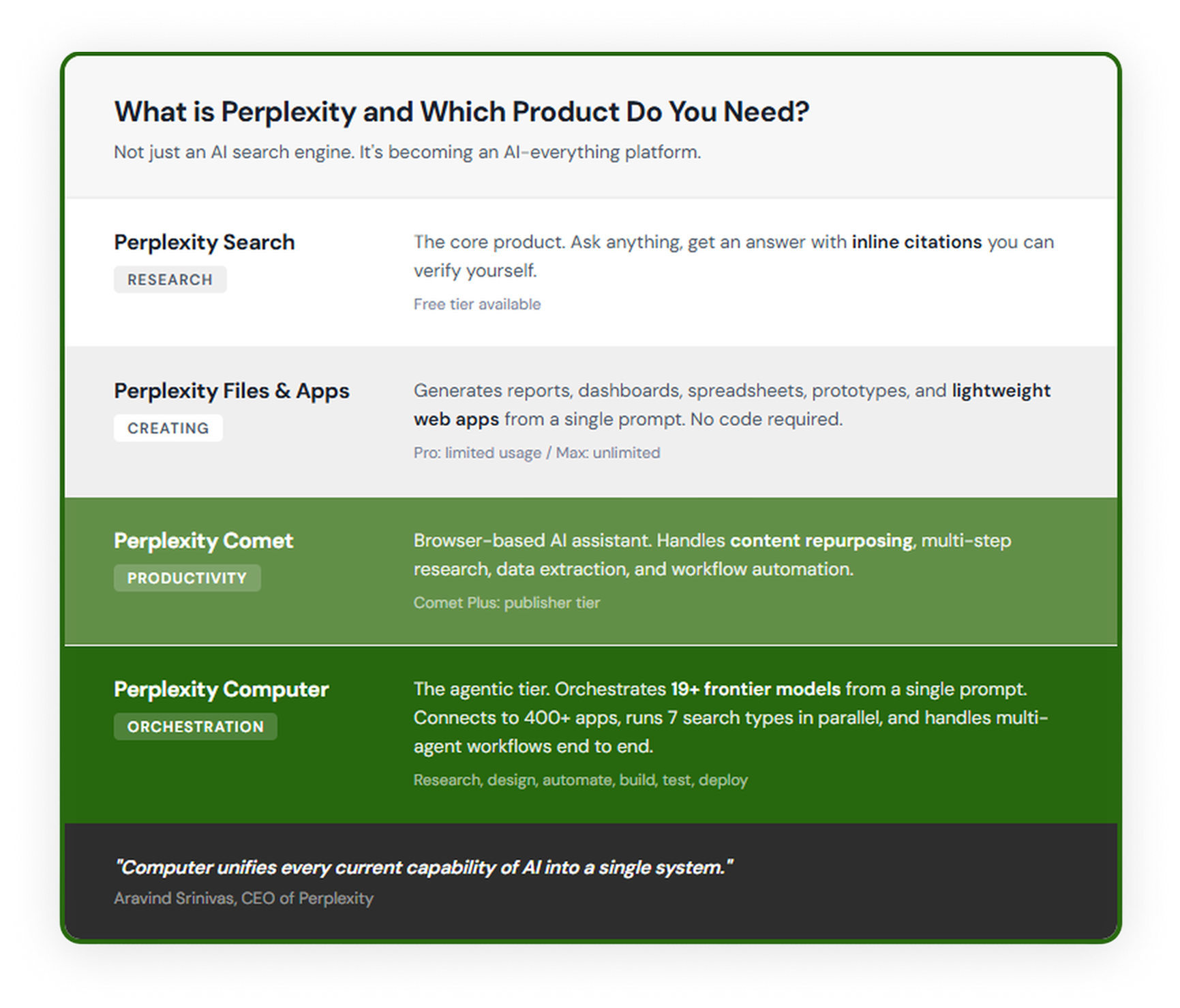
Perplexity AI is known as an AI-powered search and research platform, but I believe that framing undersells it. It’s becoming an ‘‘AI-everything’’ platform.
Four products serve different needs:
Perplexity Search is for research.
It’s the core, OG product. Ask anything, get an answer with inline citations you can verify yourself. Free tier available.
Perplexity Files & Apps (Previously known as Labs) is for creating.
It generates reports, dashboards, spreadsheets, prototypes, and lightweight web apps from a single prompt. No code required. Pro subscribers get limited usage, Max gets unlimited.
Perplexity Comet is for productivity.
Comet is Perplexity’s browser-based AI assistant. It handles content repurposing, multi-step research, data extraction, and workflow automation.
Comet Plus serves as the publisher tier (something I aspired to, until I discovered the bar is set somewhere around “global media institution.”)
Perplexity Computer is for orchestration.
It’s the agentic tier, and it’s where the wow factor lives.
It can research, design, automate, build, test, deploy, and connect to 400+ apps.
It orchestrates 19+ frontier models (including Claude Opus 4.6, GPT-5.4, and Gemini Pro 3.1) from a single prompt, with access to files, tools, and multi-agent workflows and runs seven search types in parallel: web, academic, people, image, video, shopping, social.
Computer unifies every current capability of AI into a single system.
—Aravind Srinivas
What can you build with Perplexity Computer?
Perplexity Computer Review: What I Built in One Night
I explain why Computer is novel, how it compares to Claude Cowork and OpenClaw, and what I built during my first night with it.
How to Save Credits on Perplexity Computer
I tested Computer hard to understand the pricing strategy and documented where credits disappear. This guide covers the credit system, a calibration experiment you can copy, and three workflow prompts I use to spend less.
Deep Dive: I Tested Perplexity Computer Hard. Here’s How I’d Save Credits Now
Perplexity Comet
What are the highest-impact Perplexity Comet workflows?
I ranked eleven real use cases by impact. From content repurposing to grocery shopping automation (which somehow stole the show). Includes prompts, case studies, and practical examples.
Read: 10x Your Productivity with Perplexity Comet: 11 Use Cases from “Nice” to “Wow!”
Perplexity for SEO and AIO
How do you use Perplexity for SEO, AIO, and AI discoverability?
How to run professional-grade SEO and AIO audits using JSON prompts and Perplexity Labs, without paying $15K agency fees. This post explains the system I built and how you can replicate it.
Read: How I Built a Systematic SEO & AIO Analysis Tool (And How You Can Use It With Perplexity Labs)
Make Your Site AI-Discoverable
A technical guide to implementing JSON-LD structured data and AI feed endpoints so your platform is friendly to both human visitors and AI crawlers, including Perplexity, ChatGPT, Claude, and Google’s AI Overviews.
Read: Ultimate Implementation Guide: Make Your Site AI-Discoverable with JSON-LD + AI Feed Endpoints
Making Creator Platforms AI-Discoverable
How I implemented comprehensive JSON-LD structured data and AI feed capabilities to transform StackShelf into an AI-crawler-friendly creator discovery platform. Perplexity and other AI search engines can now parse and cite the site directly.
Read: Making Your Site AI-Discoverable: A Technical Deep Dive into Modern SEO
Where does Perplexity fit in your AI stack with Claude, Replit, and others?
10 Tools for Running a Bestselling Substack in 2026
Perplexity is one of the core tools in my daily workflow alongside Claude, Recraft, and the rest. This post shows exactly how each tool fits.
Read: 10 Tools I Use To Run A Bestselling Substack Publication in 2026
The Ultimate Vibecoding Guide
A 16-step roadmap for building production-ready apps with AI. Perplexity serves as the research and fact-checking layer alongside Claude, Replit, and Cursor.
Read: The Ultimate Vibecoding Guide From Builders Who’ve Shipped
The Self-Improving Prompt System
A Prompt Builder paired with a Prompt Evaluator that scores against a 35-criteria rubric. Works across Perplexity, ChatGPT, Claude, Gemini, and any LLM that accepts structured instructions.
Read: The Self-Improving Prompt System That Gets Smarter With Every Use
Critical AI Literacy: Why Building Beats Consuming
On friction, product thinking, and why building with AI tools like Perplexity and Claude beats passively consuming AI content. This piece frames the mindset behind everything else in this library.
Read: You Can’t Critique AI You Haven’t Built With
What Makes This Library Different
Who is this for?
Anyone who uses Perplexity for real work: writers, teachers, researchers, PMs, builders, and knowledge workers. Whether you’re on the free tier or burning Computer credits daily, there’s something here.
How is this different from Perplexity’s own documentation?
Perplexity explains what the products can do. I show what works in practice: the workflows, the credit traps, the workarounds, and the use cases their marketing doesn’t cover.
To put things in perspective, I spent three weeks testing Computer before writing a single cost-saving recommendation. That’s the difference.
How often is this page updated?
Every time I publish a new Perplexity-related guide, it gets added here. The “Last updated” date at the top reflects the most recent addition. As of March 2026, this library covers 4 dedicated Perplexity guides plus cross-tool resources where Perplexity plays a key role.
This library started with a Comet use-cases post in November 2025 and grew into the one of the most comprehensive independent Perplexity resources on Substack. Every article comes from hands-on use, not recycled press releases.