

I Built A Tool Every Substack Writer Needs. And It's Not AI.
A trust-based system for building backlinks together. No spam, no SEO tricks, no admin headaches.


I’ve been staring at this idea for months without being able to name it. Something felt obvious, but just out of reach.
It kept coming back to this:
Substack runs on trust
What could we build with that trust to help each other grow?
One day, after digging myself out of another rabbit hole about SEO and AIO for my own Substack, it finally clicked.
Backlinks.
Not the spammy kind, not the Fiverr-bought kind, not the SEO-bro kind.
Backlinks done right: curated partnerships between writers who trust each other. All in service of our readers. Three minutes a week.
Hey, I’m Karo!
AI product manager and builder. I write Product with Attitude, a newsletter about building with AI and developing critical AI literacy through practice.
If this is your first time here, welcome!
Here’s what you might have missed:
→ Perplexity Computer: What I Built in One Night (Review, Examples, and How It Compares to OpenClaw and Claude)
→ Claude Cowork Guide for Power Users: 50+ Tested Tips on Plugins, Skills, Sub-Agents, and Memory

What’s Inside
Why Substack SEO and backlinks still matter in 2026.
Whether they work on Substack’s shared domain.
What Google actually penalizes vs. what’s safe.
And the tool I built so we can do this together without the admin pain.

Trust as Infrastructure
A free subscription is a small act of trust. A paid subscription is a big one.
When I pay for someone’s work, I’m saying: I trust your judgment, your taste, your way of seeing the world. When people pay for mine, they’re saying the same back.
And when I look around Substack it’s clear that the willingness to share each other’s work is already here.
What’s been missing is the infrastructure. So I built it.
Bringing in the Experts
I’m a good researcher, but I’m not an SEO expert. So I brought this to Kathleen Marrero, who focuses on SEO and entity-based search strategy.
Kathleen generously went far beyond what I asked for, bringing real expertise, care, and depth to every section of this article.
Why Backlinks Still Matter In 2026
Backlinks are links from one site to another that search engines treat as votes of confidence about credibility and relevance.
In 2026, the data still says the same thing: high-quality backlinks help pages rank higher.
Backlinks do three things:
They help search engines understand topic authority. When relevant sites link to us using natural language around our topic, they add context: this page belongs with serious resources on this topic, not random content.
They speed up crawling and indexing, because links from already‑trusted pages act like fast lanes into the search engine’s attention.
As WTF is SEO explains, internal links are little bits of SEO dust, sprinkling authority across your stories. On Substack, cross-author links serve the same function.
Why Highlighting Other Writers Makes Your Publication Stronger
I get this question surprisingly often, probably because I link to other writers constantly: aren’t you worried about giving attention to your competition?
But that assumes attention is something you should trap. And I believe that attention is something you earn by creating value.
Pointing my readers to great adjacent writers saves them time, respects their curiosity and adds value.
Connecting learners with learners and builders with builders works the same way.
So bringing this kind of curation into the community feels like the natural step.
But it takes time.
Reading newsletters to curate is the fun part. Messaging everyone to agree on which posts to link, when, and why—that can easily turn admin work. Raise your hand if you enjoy admin work. I don’t.
What This Means For Reader Experience
That’s why I think the idea is amazing, because it encourages writers to connect their work in ways that benefit readers first.
When I think about the last time I discovered a great writer, more often than not it was a link inside a post I was already reading, placed there by someone whose taste I trust.
That’s what a good backlink swap looks like from the reader’s side.
Not an ad, not a recommendation widget. A human saying: this person’s thinking belongs right here, in this context, and it’s worth your next ten minutes.
And when I’m fully absorbed in a topic, I’m past the point of needing to be talked into more reading.
LinkSwap For Substack Writers
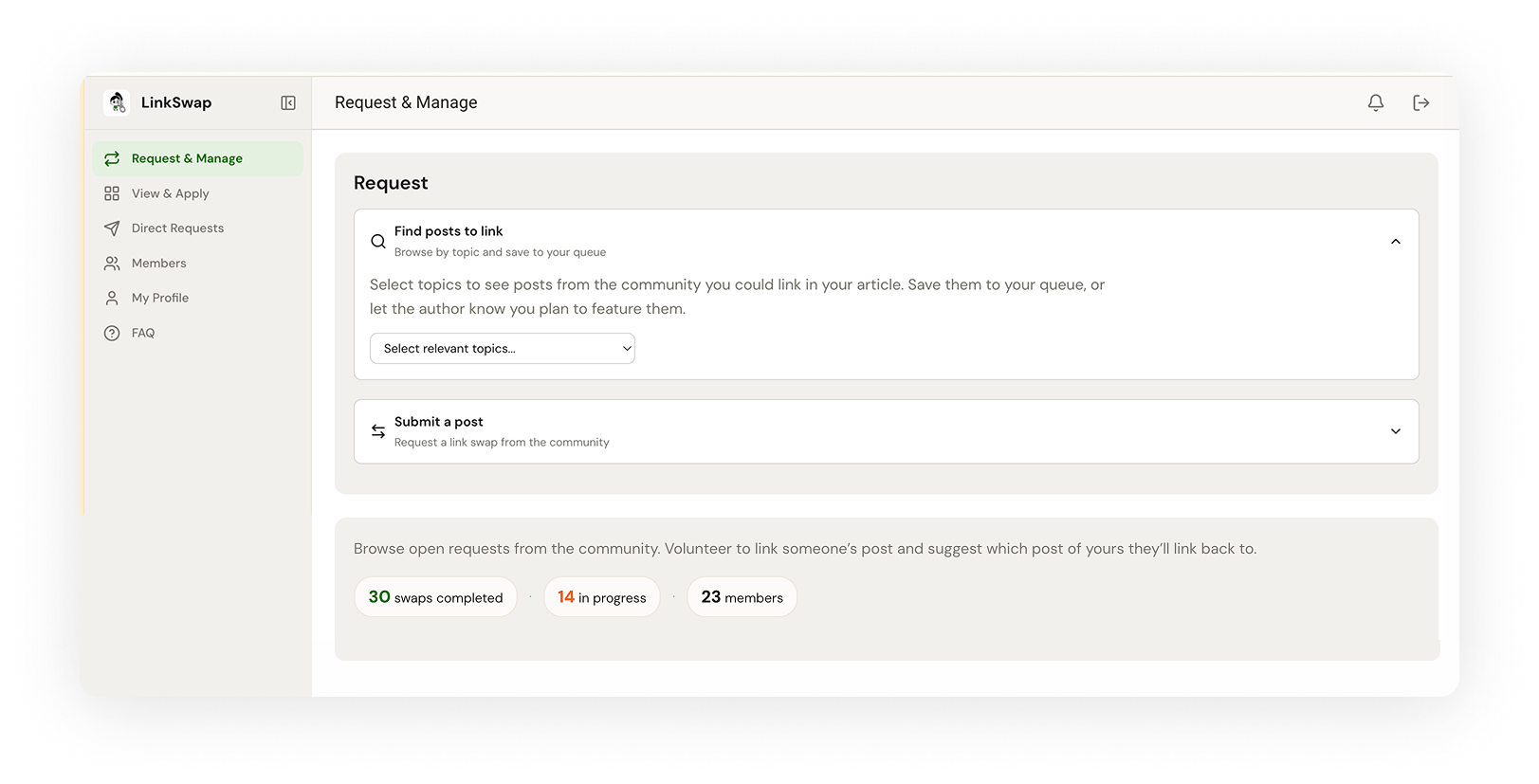
LinkSwap is a tool I built specifically for us, Substack writers, to swap backlinks in a deliberate, trackable, trust-based and non-spammy way.
The idea is simple:
Post a request. Let other writers know what you wrote about and that you’re open to a backlink collaboration.
Respond. Other writers propose a match. You read their articles and accept or not.
Swap. Both parties add the links and confirm once links are live.
Track. Who linked whom, in which post.
Filter by topic and find swaps that make sense for your audience.
The philosophy underneath: use existing trust to create new pathways. If I already trust your work enough to subscribe or pay, linking to you is service to my readers.
From Kathleen Marrero:
Think of the network of writers as a knowledge ecosystem.
When multiple writers consistently reference each other on a shared topic, it helps search engines understand the conversation around that topic.
Search engines increasingly rely on relationships between content rather than evaluating isolated pages.
Done systematically, without gaming anything, this builds a network of high-quality, contextual backlinks that help readers discover more good work, help writers grow their audiences, and help search engines see the shape of our corner of the internet more clearly.
SEO Questions I Needed To Clarify
Same Domain Backlinks
I was unsure whether backlinks even matter when most of Substack writers share the same domain.
They do.
Even on a shared domain, links still signal topic authority and help search engines cluster content around trusted sources. They affect how content is crawled, discovered, and where authority clusters.
From Kathleen Marrero:
These links function somewhere between internal links and traditional external backlinks. They can still help with discovery and provide topical context, but they don’t carry the same authority signal as links between fully independent domains.
Where the concept becomes especially interesting, in my view, is less about backlink swapping and more about discovery pathways.
When writers connect their work through relevant citations, they create routes for both readers and search engines to explore related ideas.
Sprout Social’s Substack SEO guide puts it plainly:
Invest in backlinks through community.
And Ali Tanweer independently verified this; all outbound links on Substack are dofollow by default, passing real link equity.
Link Farms & Penalties
Another thing I needed to dig deeper into was the difference between link farms (excessive link exchanges done purely to manipulate rankings) and natural, relevant link swaps between two quality articles.
What Google penalizes is scale and manipulation:
Automatically injected links with no editorial judgment behind them
Large-scale link schemes across hundreds of unrelated sites
Private Blog Networks (PBNs): fake independent sites secretly owned by the same person, built purely to manufacture links
From Kathleen Marrero:
The difference between manipulative link exchanges and healthy linking behavior comes down to intent and context.
When links are created purely to influence rankings, patterns become easy for search engines to detect.
But when writers reference each other’s work because it genuinely adds perspective or depth to a topic, those links behave more like citations.
They help build a network of related ideas, which is how search engines increasingly understand expertise in the age of entity-based search.
What Google Recommends
Editorial justification: the link helps the reader find something genuinely useful, not just boost a metric
Topical relevance: both articles are about related subjects; links between unrelated sites trigger suspicion
Natural anchor text: varied, descriptive language rather than exact-match commercial keywords repeated every time
Low reciprocal ratio: link exchanges staying well under 10–30% of your total backlink profile look organic; heavy reliance on reciprocal links alone does not
Diverse link profile overall: you also get links from social mentions, podcast notes, editorial citations, and other non-reciprocal sources, so swaps are one signal among many
No patterns or clusters: you’re not linking to the same five sites in every post in an obvious ring structure
From Kathleen Marrero
The bigger shift happening in search is that authority is increasingly determined by how knowledge connects across sources.
When writers link to relevant work from others in their field, they’re not just sharing links; they’re helping build a semantic map of a topic.
Those connections help search engines understand which people and publications are shaping the conversation.
What Makes LinkSwap Different
What I want is the opposite:
Human-scale. Few writers, not two thousand bots.
Topic-aligned. You write about the same things your link partner does.
Reader-first. The link goes where your reader would genuinely benefit from going next.
The scale is small and organic: individual writers choosing specific posts to cross-reference.
Why LinkSwap is Free For Premium Members
I don’t want LinkSwap to become a random marketplace where people show up with low-effort content chasing quick SEO wins.
I want to use it as a collaboration engine. A trust-driven network of writers pointing to each other’s best work.
If you’re paying for my work, you probably care about quality, ethics, and long-term thinking. Limiting access to a group with shared values keeps the network clean and useful, instead of racing to the bottom on volume.
In other words, trust is both the foundation and the filter.
That’s why LinkSwap is free for all premium Product with Attitude members.
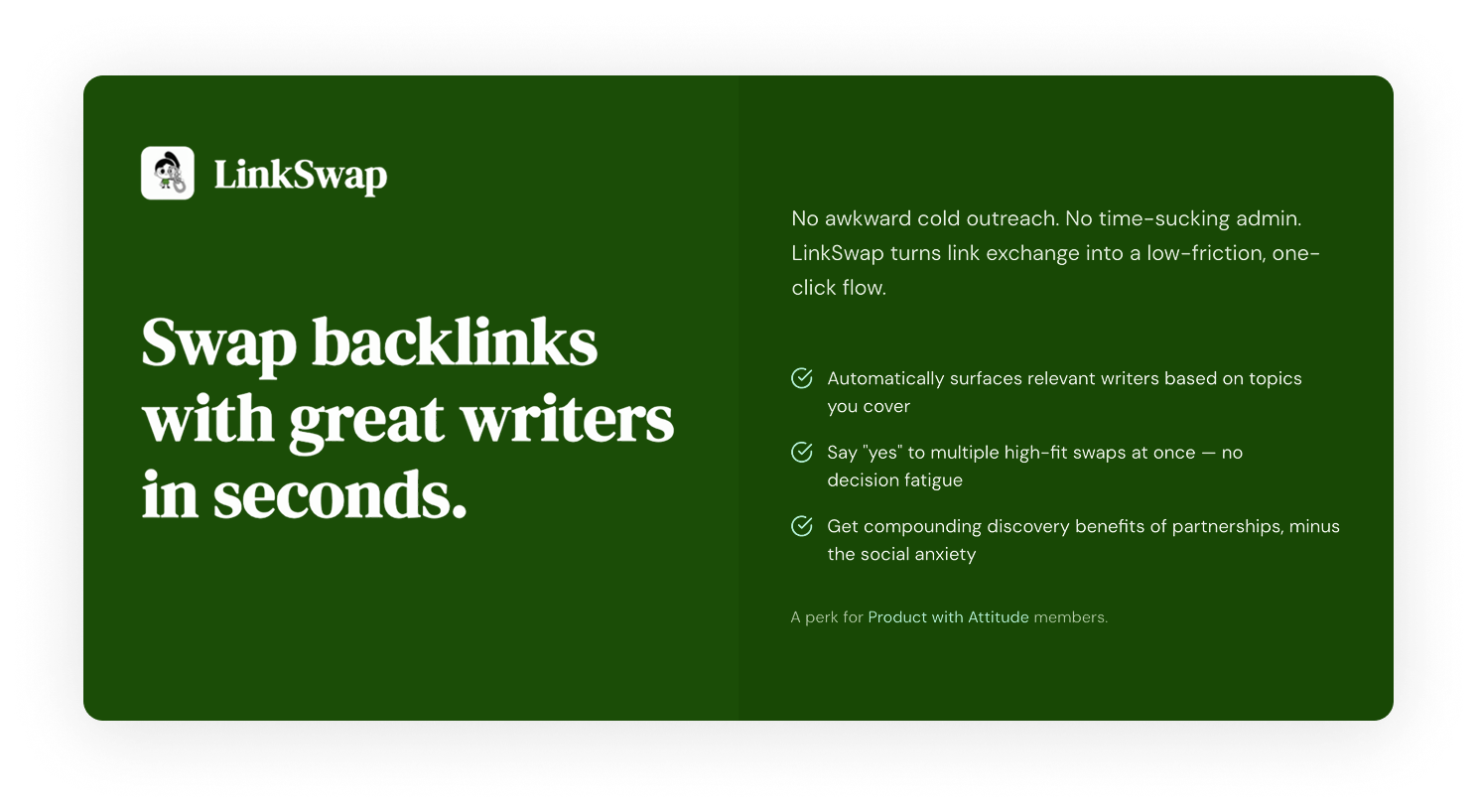
If you’re a part of the premium crew, you get access and a chance to share your work with a community that helps each other grow.
Join LinkSwap
The Experiment We Can Run Together
Start from your readers. What would they genuinely benefit from reading next?
Find writers in adjacent lanes whose work you already respect.
Set up a few intentional swaps over 30, 60, 90 days, and watch how they shape your newsletter growth.
Track what happens: search impressions, new subscribers, engagement.
But also the softer stuff:
Emails saying I found you through Mr B.
Conversations that only happened because someone clicked that link in the middle of your post.
Try it, and let us know what you discover.
Because the best systems for growth aren’t competitive, they’re collaborative.
Big Thanks To The Beta Team

LinkSwap wouldn’t be half as good as it is today without the generous, detailed feedback from the 22 beta testers.
If you’re building something and want solid, honest, well‑researched feedback, make sure you’re subscribed to:
Dheeraj Sharma, Ileana, Tracy Friedlander, Jenny Ouyang, Joel Salinas, Marcela Distefano, Kacper Wojaczek, Dr Sam Illingworth, Daria Cupareanu, Xian, Dee McCrorey, Karen Spinner, Raghav Mehra, Nirav Bhatt, Tina Nayak, Kim Doyal, Dallas Payne, Jeremy Wright - Marketer/ECHO, Mia Kiraki 🎭 Elena | AI Product Leader, Juan Gonzalez, AI Meets Girlboss.
You Might Also Enjoy

LinkSwap is an amazing extension tool for linking and finding useful references. I used it for one of my articles too. Thank you so much for building it and inviting me to be a beta tester. I look forward to integrate is a part of my publication posting workflow. 🚀✨
This is an absolutely brilliant product, Karo. Thank you so much for building it and also inviting me to be one of the beta testers. I've loved using it, and I'm really excited to keep doing so as part of my Substack workflow.