

How Boris Cherny, Builder of Claude Code, Uses It — And Why That Should Change How You Think About AI
The viral X thread that broke the developer internet.

If a person who invented the oven waits for it to heat properly, you do the same.
If the camera designer adjusts the lightning settings, you do the same.
If the car maker buckles the seatbelt first, you do the same.
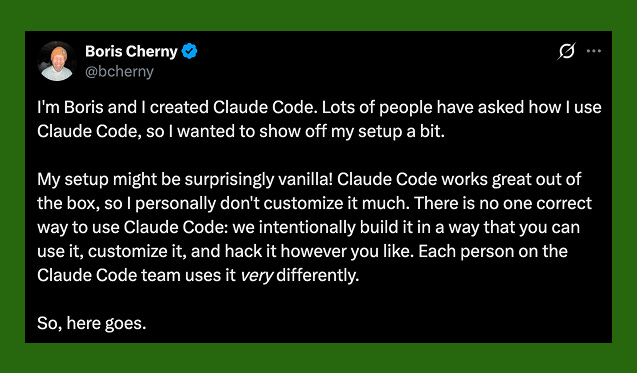
So even though I didn’t plan to write another post this week, after reading Boris’ tweet, I knew I had to pass his best practices along.
Hey I’m Karo 🤗
AI product manager, builder of StackShelf.app, Attitudevault.dev, and someone who believes the most valuable lessons come from people who invent tools and then use them themselves.
If you’re new here, welcome! Here’s what you might have missed:
Claude Skills Are Taking the AI Community by Storm
n8n AI Agent Builder for Claude Code
A Creator’s Guide to Building a Reusable Visual System
Build With Attitude
Boris Cherny is a Staff Engineer at Anthropic who helped build Claude Code. Today we’re going to look at how he uses it, what he does, what he avoids and, more importantly, what it means.
#1 He Runs a Fleet of Claudes in Parallel
What he does
He keeps ~10–15 concurrent Claude Code sessions alive: 5 in terminal (tabbed, numbered, with OS notifications). 5–10 in the browser. Plus mobile sessions he starts in the morning and checks in on later. He hands off sessions between environments and sometimes teleports them back and forth.
What this means
Why this matters: Boris doesn't see AI as a tool you use, but as a capacity you schedule. He’s distributing cognition like compute: allocate it, queue it, keep it hot, switch contexts only when value is ready.
The bottleneck isn’t generation; it’s attention allocation.
How he sees agents: Each session is a separate worker with its own context, not a single assistant that must hold everything. The “fleet” approach is basically: don’t make one brain do all jobs; run many partial brains.
What it means for vibe coders: This is fascinating and goes beyond prompt engineering or context engineering - to pipeline design: multiple pieces in flight, you only touch what’s ripe.

#2 He Uses the Slowest, Smartest Model by Default
What he does
He uses Opus 4.5 with thinking for everything, even though it’s bigger & slower. Because the quality he gets that way makes the whole process faster.
What this means
Why this matters: He’s optimizing for total iteration cost. Single output speed is a vanity metric.
A wrong fast answer is slower than a right slow answer.
How he sees responsibility: He’s implicitly acknowledging the “correction tax”: every hallucination or half-right patch charges human attention. His choice is to pay compute to reduce human oversight load.
What this means for vibe coders: Don’t optimize for cost per token, optimize for cost per reliable change.
#3 He Maintains a Shared CLAUDE.md That Turns Mistakes Into Institutional Memory
This is one of my favourite takeaways.
What he does
His team keeps one shared CLAUDE.md checked into git. Everyone updates it multiple times a week. The rule: when Claude does something wrong, add it so it doesn't repeat. Each team owns keeping theirs up to date.
What this means
Why this matters: AI is powerful but forgetful by default. You must provide memory externally. It’s an artifact you help maintain.
How he sees responsibility: He’d rather pay once (write the rule) than double check everything all the time.
What this means for vibe coders: This validates what I wrote in If You Build With AI, You Need This File.
CLAUDE.md is your product’s safety rails:
never touch prod,
always run tests
preferred architecture, etc.
#4 He Uses Claude in Code Review to Update the System, Not Just to Approve a PR
What he does
In reviews, he’ll tag @.claude on coworkers’ pull requests to add learnings to CLAUDE.md, using the Claude Code GitHub action.
What this means
Why this matters: Code review isn’t only for catching bugs; it’s for training the development system. Review becomes meta-work: improving the process that produces code.
How he sees agents: Agents belong inside the team’s social workflows (PRs) as participants that can update shared norms. That’s a strong stance: agents aren’t a side tool; they’re part of the collaboration loop.
What this means for vibe coders: If you build with others, consider treating PR reviews as the place you encode product standards, so the future agent outputs stop degrading.
#5 He Plans First, Then Lets Claude Run
The ever-planning PM in me was very happy reading this one.
What he does
He starts in Plan Mode, iterates until the plan is good, then switches into auto-accept edits mode. Claude can execute the entire implementation in one go without needing back-and-forth revisions.
What this means
Why this matters: AI works best when it can commit to a structured plan: what to do, in what order, why. Plan Mode forces explicitness before execution.
What this means for vibe coders: This prevents the classic failure: when the agent thinks it’s helpful and makes 40 changes you didn’t want. Don’t let a system act before you’ve agreed on intent and constraints. Plan mode is part of the speccing process.
#6 He Uses Subagents as Reusable Workflow Atoms
What he does
Boris treats subagents like slash commands.
What this means
How he sees agents: Agents are not "one big agent." They're modular roles. Reliability comes from specialization plus constraint.
How he sees coding: Coding becomes a pipeline of phases: spec, draft, simplify, verify. Each phase benefits from a different "mind."
How he sees responsibility: Best practices get encoded into tools that run automatically. That’s ethics-by-design: fewer failures from fatigue.
What this means for vibe coders: Consider building one agent that writes PRDs, one that codes, one that checks UX.
If you’ve read my post on prompting, you may recall that I also use a similar setup to build and evaluate all my prompts.
#7 He Runs a PostToolUse Hook
What he does
Boris runs a PostToolUse hook that formats Claude’s code, because Claude is “usually” well-formatted, and the hook fixes the last 10% to avoid CI failures.
What this means
How he sees coding: The craft shifts from writing perfect code to building systems that do it.
How he sees ethics/responsibility: This aligns with Anthropic's "power tool" framing: Claude Code is low-level and scriptable, so you should build guardrails around it.
What this means for vibe coders: Consider using hooks to stop AI from quietly breaking lint/format/typecheck. Otherwise you'll hate it.
#8 He Avoids “Dangerously Skip Permissions”
What he does
Instead he uses /permissions to pre-allow common safe commands, shared across the team.
What this means
Why this matters: He treats permissions as a team asset. Shared, reviewable, and versioned. Pre-allowing safe actions makes the right thing the default. Shared and versioned permissions means your system remembers where it's allowed to go when you're tired, rushing, or experimenting.
What this means for vibe coders: Skipping permissions shifts risk onto future you, your users, or your team. Design boundaries you won’t regret crossing automatically.
#9 His Non-negotiable: Verification Loops
What he does
Boris calls this “probably the most important thing”.
He gives Claude a way to verify its work: open a browser, test the UI, and iterate until it works.
What this means
How he sees agents: The best agents are the ones that can check and self-correct. This is the strongest responsibility claim in the whole thread:
You don’t trust; you instrument.
What this means for vibe coders: Remember to give Claude a way to verify its work. It improves quality 2-3x.
Key Takeaways
Boris treats Claude Code like infrastructure, not magic. He builds systems around it: memory files, permission configs, verification loops, formatting hooks. He runs it in parallel because he’s optimizing for throughput, not conversation.
Most people ask: “How do I get better outputs from AI?”
Boris asks: “How do I build a system where AI reliably produces what I need?”
That’s the difference between using a tool and engineering with one.
The inventor waits for the oven to heat properly not because he’s patient, but because he knows what happens when you don’t.
You Might Also Enjoy

Join hundreds of Premium Members and unlock everything you need to build with AI. From prompt packs and code blocks to learning paths, discounts and the community that makes it so special.
Karo, I swear you are a linguistic Surgeon, it's amazing that you're able to break all of this down from that tweet and to be able to share it with all of us in public as well. Bookmarking this for later, as I've just entered the world of vibe coding, inspired mainly by your wonderful posts. Thanks again for the reminder of what I can hopefully achieve in the not-too-distant future.
Great summary! He shows that you don’t need to overcomplicate things to make the best use of the tool, sometimes less is more. I also agree with how he thinks about agents: the smaller the task, the better, since it’s easier to reuse and debug if needed. I believe tiny tasks in the form of agents are the way to go.