

Why Substack Has No Gurus: 6 Product Decisions That Killed Guru Culture by Design
Most platforms reward guru energy by design. Substack made six choices that prevent it.

The garden has no guru. It has biodiversity.
I’ve been thinking about this since Hamish McKenzie ’s TED Talk in April. He laid out three eras of media:
the temple: top-down, gatekept,
the chaos: algorithmic free-for-all,
and now: the garden.
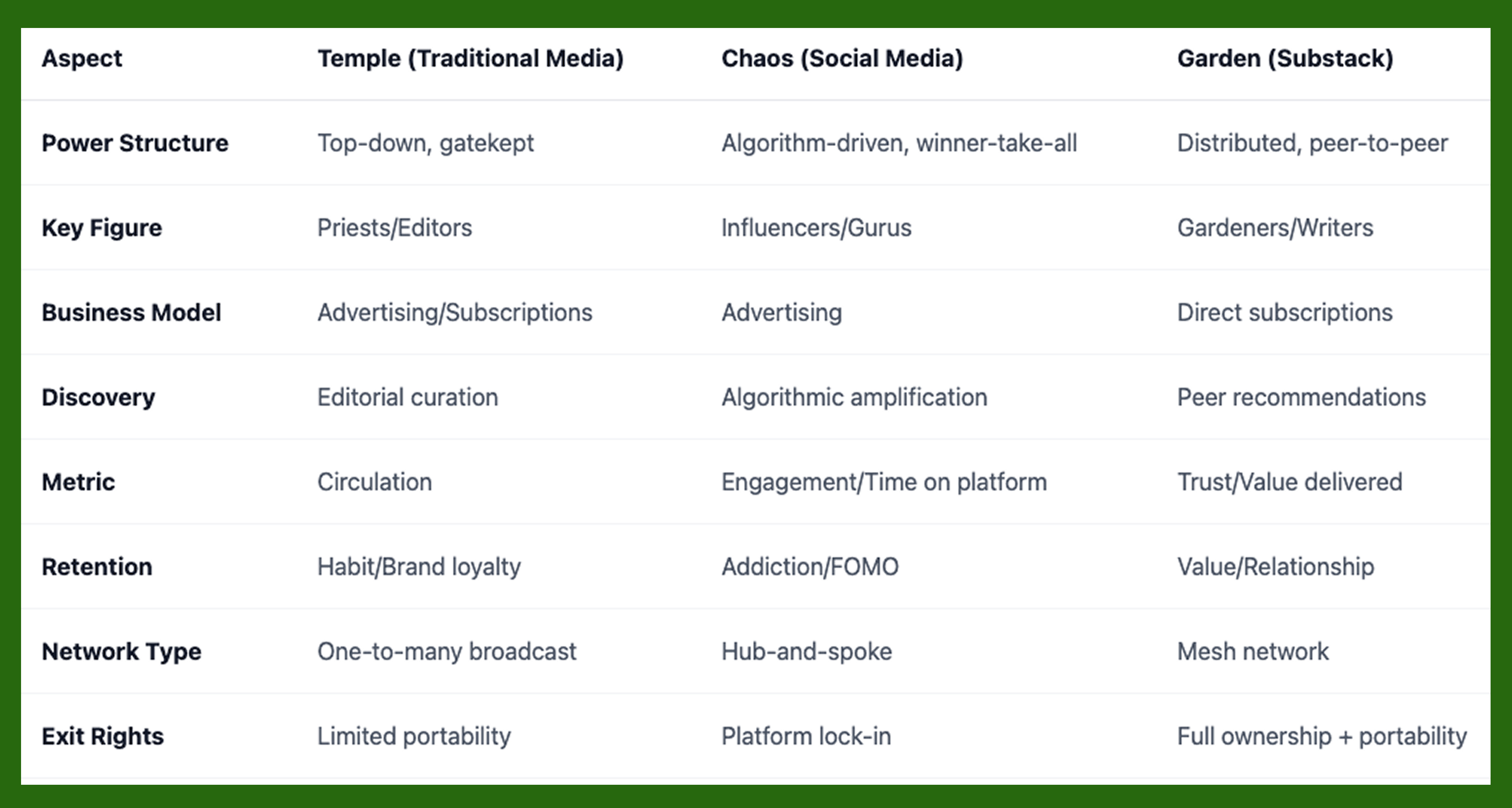
The temple had priests. The chaos had influencers. The garden has gardeners.
And gardeners are structurally incapable of becoming gurus. Not only because of culture (although that’s a big part of it), but also because of Substack’s product architecture.

Hey I’m Karo 🤗
I’m an AI product manager, builder of StackShelf.app, Attitudevault.dev, and I build platforms for a living. The platform model behind Substack is one of the most fascinating I've ever studied. Today, I'll show you why.
If you’re new here, welcome! Here’s what you might have missed:
10 Tools I Use To Run A Bestselling Substack Publication in 2026
10 Mistakes I Won’t Repeat On Substack In 2026
The Business Model Killed Guru Energy Before It Started
Substack’s founding story is itself an anti-guru parable.
Chris Best drafted a blog post in 2017 about everything wrong with the attention economy. Hamish McKenzie read it and said: everybody already knows the problems. Nobody knows what to do about them.
Chris never finished the blog post. He built Substack instead.
The core insight was a single structural inversion:
stop treating advertisers as the customer
start treating readers as the customer
When advertisers pay, writers serve the algorithm. When readers pay, writers serve readers.
This is a product decision with massive second-order effects.
Ad-supported platforms optimize for time on platform.
That’s the metric. And the fastest path to time on platform is outrage, parasocial dependency, and one-to-many broadcasting. Guru energy is rewarded in this ecosystem.
Subscription-supported platforms optimize for value delivered. The metric is trust earned. You don’t retain a paying subscriber with rage bait. You retain them by being worth $5 a month, every month.
Hamish McKenzie put it sharply: traditional media has a physical illness (broken business model). Social media has a mental illness (broken discourse). Substack was designed to treat both.
Gurus need algorithms that amplify a single voice to millions.
Gardeners need relationships rooted in trust.
Trust As The Growth Engine
I went from I’ll never pay for anyone's writing to having 25 paid subscriptions in 12 months. Here's why.
Trust builds slowly on Substack. Post by post. Month by month.
There are writers like Dr Sam Illingworth, Jenny Ouyang, Daria Cupareanu, Kacper Wojaczek, Elena | AI Product Leader, Mia Kiraki 🎭, Karen Spinner, Finn Tropy and Joel Salinas (to name a few) that I trust so much, I’d be willing to like their post without reading them.
They’ve all earned it.
Each of their articles delivered something I could take home and use, or nudged my thinking just enough that I had to stare at the wall for a minute, or gave me something that my brain flagged as interesting before I could even articulate why.
And here’s the product angle: that kind of trust only exists because the system rewards consistency, not virality.
When a writer isn't chasing virality, they can be the same person in post #3 and post #300.
But if we look at gurus, we’ll notice that they don’t actually need trust. They need algorithms.
Discovery by Peers, Not Machines
The guru model needs an algorithm to function. It concentrates attention on a few voices through virality loops:
One person goes viral ➜ a million people listen ➜ power concentrates.
This is the winner-take-all distribution pattern that most social platforms are designed around.
The algorithm identifies high-engagement content, amplifies it, which creates more engagement, which triggers more amplification. It’s a positive feedback loop that mathematically guarantees power concentration.
Substack’s discovery system breaks that loop.
Writers recommend writers. Not machines. People.
Recommendations now drive 50% of all new subscriptions and 25% of paid subscriptions on Substack. All peer-driven. Not because an algorithm surfaced our work, but because a reader found value in it and told someone.
When Substack rebuilt its algorithm in late 2025, the design philosophy was explicit:
the algorithm’s job isn’t to generate endless engagement
it’s to match subscribers with work they value and want to support
You can’t become a guru on a platform where other writers and readers control who gets recommended.
Exit Rights Are Anti-Lock-In
This is the one that product people should pay the most attention to.
Every PM knows the two approaches to retention:
Retention through friction: make leaving expensive. High switching costs. Proprietary formats. Data you can’t export. Audiences you can’t take with you. This is the default playbook and it works. It also creates the conditions for guru dynamics because followers have invested so much in a single ecosystem that leaving feels impossible.
Retention through value: Make it easy to leave for everyone, but make staying irressistible. On Substack, writers own their mailing lists and their payment relationships via Stripe. They can leave at any time, and so can their readers.
This model is harder to execute. It’s also the only model compatible with healthy relationships.
When both the writer and the reader can leave at any time, the relationship has to be continuously earned, not extracted.
Most platforms treat lock-in as a moat. Substack treats portability as one. That’s the kind of counterintuitive product decision that only makes sense when you’ve correctly identified what you’re actually selling: not content, but trust.
Horizontal, Not Vertical
Gurus need an audience that looks up.
Substack’s best features create a space where people look across, at each other.
This maps directly to a product architecture choice every platform makes: hub-and-spoke vs. mesh network.
Hub-and-spoke puts the creator at the center. Every connection flows through them. That’s Instagram. That’s YouTube. That’s guru topology.
Mesh network distributes connections across all participants. Readers connect to the writer, but also to each other, and to other writers, and to other readers of those writers. That’s what Substack’s community features are designed to enable.
From a product metrics standpoint, this is also revealing. Hub-and-spoke platforms measure follower count as the primary creator metric. Mesh networks measure engagement depth: insightful comments, cross-recommendations, community activity.
Those metrics tell you what the system values:
attention or relationship
scale or reciprocity
extraction or care
Long-Form Is Naturally Guru-Resistant
This one is under-appreciated.
Yes, you can send reels on Substack; but it’s not the core of their product architecture.
Reels and tweets are the guru’s natural habitat. You can consume a 60-second reel passively. The guru talks. The audience absorbs. Nobody has to think.
In product terms, reels have zero cognitive friction. It’s designed that way:
low friction is great for engagement metrics.
it’s terrible for critical thinking. And critical thinking is the natural enemy of guru dynamics.
Reading a 2,000-word essay is different. The reader has to think. We have to actively engage with each paragraph, each argument, each turn. That’s inherently resistant to guru dynamics.
The choice to build around long-form writing isn’t just a content preference. This is a format-as-feature decision.
You can’t parasocially bond with someone whose work requires you to disagree, highlight, re-read, and form your own opinion. That’s not discipleship. That’s dialogue.
And here’s where AI makes this even more interesting.
AI can produce a guru's output. Confident pronouncements, one-size-fits-all advice, polished authority. That's 100% automatable today. Many of my readers could ship content like that tomorrow. We choose not to.
And my assumption is that the more AI floods the internet with guru-energy content, the more valuable the anti-guru, original voice becomes.
Six Product Decisions, One Architecture
Let me pull this together as a product lens:
Subscription model: Writer serves reader, not the algorithm. The revenue model determines the incentive structure. The incentive structure determines the culture.
Garden ecosystem: Distributed power. Everyone decides who they want to support and recommend. No single voice at the center. Biodiversity over monoculture.
Peer-to-peer recommendations: Discovery driven by writers recommending writers, not machine amplification of a few. Distributed network topology, not centralized resource allocation.
Full ownership and exit rights: No lock-in. Relationships must be continuously earned, not extracted. Portability as moat, not portability as threat.
Horizontal community tools: Readers connect with each other, not just look up at the writer. Mesh network, not hub-and-spoke.
Human-first, long-form format: Can’t be consumed passively. Requires active reading and is resistant to both parasocial dependency and AI commodification.
Substack isn’t just culturally anti-guru, it’s architecturally anti-guru. Baked into the business model, the discovery system, the community features, and the founding philosophy.
This is what good product thinking looks like: not a mission statement about being different. Six interlocking design decisions that make a specific outcome, like guru concentration, structurally difficult to achieve.
Key Takeaways
If you’re building on Substack, optimize for the things the platform rewards. Consistency over virality. Depth over reach. Trust over follower count. Conversation over broadcasting.
And stop optimizing for the things it doesn’t. Algorithmic hacks. Growth shortcuts. Content that sounds impressive but says nothing. The platform wasn’t designed for that.
And neither were your readers.
From The Community
I Tested Substack’s Restack Feature Every Day for 30 Days. I Gained 900+ Subscribers by Wes Pearce
How I almost became one of those “writing gurus” you hate by Michelle Schusterman

Join 12K Members and unlock everything you need to experiment and build with AI. From learning paths to prompt packs and code blocks, discounts and the community that makes it so special.
Thanks for the shout-out, Karo — and wow, this is a thinky piece. You clearly put real time and brainpower into it.
Substack’s architecture and product design are absolutely worth studying, and what’s wild is how much of it creators never even see in the UI (yet). I’ve spent the last 14+ months poking around their undocumented backend APIs, and honestly… every debug session feels like opening a Kinder egg. Always some new surprise inside.
Your take on the business model and discovery mechanics really lands. Relationships matter way more than people want to admit. Right now, recommendations are driving about 2× as many subscribers as Notes, and I’m seeing the same pattern across other creators too.
I especially liked your point about trust taking time. It naturally kills off “guru mode” and rewards “build in public” behavior instead — more touchpoints, more context, more real signals that a creator is actually doing the work.
I’m saving this one because it’s the kind of post you have to reread to fully digest.
Thank you for writing it 🙏
Thanks so much for the shout out! I trust you enough to recommend your work without reading it…although I always read your posts because they’re great! 🤗
Agree that Substack has a unique model for encouraging publications to reward readers over advertisers, and I’m curious how or if this might change as Substack rolls out its sponsorship network. 🤔
Also, Substack really needs to make tax and compliance easier for small creators…saying this as I look into whether I need to register as an EU business entity and pay VAT tax on my handful of paid subscribers in Europe. 🫠