

What llms.txt does, what goes inside it, who uses it, and why more AI citations are not a proven benefit.
If you have been reading about AI search, you have probably seen this advice:
Add an llms.txt file to your website.
The argument usually follows this pattern: give ChatGPT, Claude, Perplexity, and Google a special file that explains your website, and AI systems will understand your content better.
Sometimes the next claim is that this will help you appear more often in AI answers.
That second part is where things get wobbly.
llms.txt is a real proposal. It has a sensible technical purpose. AI labs and documentation platforms publish it. I use it too and I’ll soon write another article explaining the benefits from my tests.
But the current evidence does not show that adding one makes ChatGPT, Google AI Overviews, or other AI search systems cite your site more often.
Those are two different jobs.

What Is llms.txt?
llms.txt is a Markdown file that gives AI agents a short, curated guide to a website.
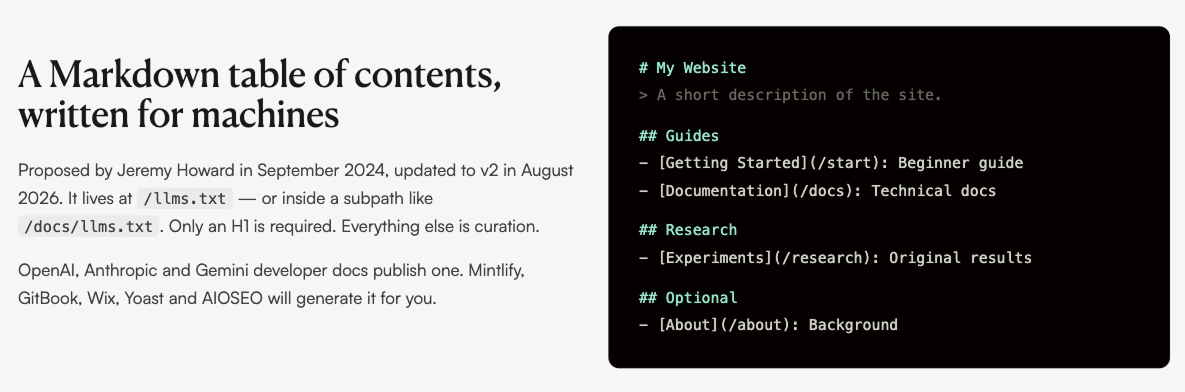
Jeremy Howard published the original proposal in September 2024. The specification received a major v2 update in August 2026. The original problem is very practical.
Web pages are made for humans. They contain navigation, scripts, ads, menus, cookie notices, styling, and other material an AI agent may not need.
An llms.txt file is part of the AI-facing interface, kind of like someone standing at the supermarket door and helping an AI navigate every aisle.
Documentation is aisle three. API references are on the left. Tutorials are on the right.
That is roughly the job of llms.txt. I find it useful to think about llms.txt as an agent map, not a citation magnet.
Where does an llms.txt file live?
Your website can place the file at:
example.com/llms.txt
A documentation section can also have its own file:
example.com/docs/llms.txt
The file tells an agent what the site or section contains. It can then point the agent to useful pages.
What Goes Inside an llms.txt File?
The current specification is deliberately simple. The file is meant to remain small. The detailed information stays on the pages it links to.
The only required part is an H1 heading with the project or website name.
You can then add:
a short description
extra instructions or context
sections grouped under H2 headings
links to useful pages
short descriptions of those links
The official specification gives a structure similar to this:
# My Website

> A short description of what this website contains.

Information that helps an agent understand the site.

## Guides

- [Getting Started](https://example.com/start): Beginner guide
- [Documentation](https://example.com/docs): Technical documentation

## Research

- [Experiments](https://example.com/research): Original research and results

## Optional

- [About](https://example.com/about): Background information
That is basically it.
llms.txt vs robots.txt vs sitemap.xml
These files sound similar because they all sit around the technical side of a website.
They have different jobs.


robots.txt contains crawl instructions for bots that follow them. It does not enforce access restrictions.
A sitemap is closer to an inventory.
llms.txt is closer to a hand-written table of contents.
The official specification says llms.txt is designed to work beside these existing standards, rather than replace them.
Why Was llms.txt Created?
The idea becomes much easier to understand when we stop thinking about SEO for a moment.
Imagine you are using a coding agent.
You ask:
How do I authenticate with this API?
The agent lands on a documentation site with 4,000 pages.
Without guidance, it has to find the relevant documentation itself.
An llms.txt file can point directly to:
authentication documentation
API references
tutorials
migration guides
known limitations
That can save requests, tokens, and time. Which we want.
This is why llms.txt makes particular sense for technical documentation. OpenAI, Anthropic, and Gemini developer documentation are among sites that publish these files.
Platforms have started supporting the format too.
Mintlify and GitBook can generate it for documentation sites.
Wix generates one for its sites.
Yoast and AIOSEO offer tools for WordPress.
So yes, llms.txt has a purpose. It just isn’t citation frequency.
Does llms.txt Help You Get Cited by AI?
Based on current evidence, there is no demonstrated citation benefit from adding the file. The studies below examine different questions: SE Ranking looked at citation frequency; Ahrefs and OtterlyAI measured requests to the file.
That surprised me because I had spent real time maintaining my own machine-readable content.
For a while, I assumed it was helping explain why my work started appearing in AI search.
Then larger studies began arriving.
And they were not kind to that hypothesis.
SE Ranking: 300,000 Domains
SE Ranking examined nearly 300,000 domains and compared llms.txt adoption with AI citation frequency.
It found no correlation between having an llms.txt file and being cited more often by LLMs.
The researchers also included llms.txt in an XGBoost model designed to predict citation frequency.
When they removed the llms.txt variable, the model became more accurate.
In other words, the file did not help explain citation frequency. It added noise.
Ahrefs: 137,210 Domains
Ahrefs looked at server logs and traffic from 137,210 domains. About 38,000 of them had a valid llms.txt file.
In May 2026, 97% of those files received zero requests.
Nothing fetched them.
Among the small share that did receive requests, many requests did not come from AI search systems at all.
OtterlyAI: 90 Days of Server Logs
OtterlyAI ran a 90-day experiment and recorded more than 62,100 AI bot visits.
Only 84 requests went to /llms.txt.
That is about 0.1% of the AI bot traffic they measured.
The site’s average normal content page received about 265 AI bot visits during the same period.
Again, this does not say nobody will ever use your llms.txt file. It says the file received very little attention compared with the site’s normal pages.
Google Is Even More Explicit
Google published an official AI Optimization Guide for websites that want to appear in AI Overviews and AI Mode.
Its guidance includes llms.txt in the section about things website owners do not need for Google Search.
Google says Search does not use llms.txt.
This creates an interesting split.
Google Search says it does not use the file for search visibility.
Chrome’s Lighthouse has added checks for llms.txt as part of its work around agentic browsing. The file is optional: if it is missing, Lighthouse marks the audit “Not Applicable.”
An AI agent reading your website is not the same system as an AI search engine deciding whether your website deserves to be retrieved and cited.
Helping an Agent Use Your Website
Retrieval is not ranking. A file can make information easier for an agent to consume without making the source more likely to be selected.
Imagine handing a customer inside your restaurant a beautifully formatted menu. You have made ordering easier for someone who is already inside. You have not made more people choose that restaurant.
llms.txt can work the same way.
It can help an agent that already wants information from your website.
That does not mean ChatGPT, Perplexity, or Google will decide to retrieve your website more often.
And it does not mean they will cite it.
So Should You Create an llms.txt File?
Possibly.
I would use one when:
your website contains technical documentation
AI agents need to find specific information on your site
your CMS generates and updates the file automatically
keeping it current takes very little work
you want to experiment with agent-readable website infrastructure
I would put it much lower on the list when your only goal is:
more Google AI Overview citations
more ChatGPT citations
more Perplexity citations
more search traffic
better rankings
For those goals, the evidence points elsewhere.
Google tells site owners to focus on crawlable pages, useful site structure, and original non-commodity content. Its generative AI systems retrieve information through the same Search infrastructure used to find web pages.
SE Ranking’s citation research also points toward factors such as links and wider website authority rather than llms.txt.
That is less satisfying than installing one clever text file.
It is also much closer to how retrieval systems work.
FAQ
What does llms.txt stand for?
The name refers to large language models, or LLMs. An llms.txt file is a Markdown document that gives AI agents a curated description of a website and links to useful resources. The proposal was first published by Jeremy Howard in 2024 and updated to v2 in August 2026.
Where does llms.txt go?
The common location is /llms.txt at the root of a website. The v2 specification also supports files inside subpaths, such as /docs/llms.txt, where the file describes content under that path.
Is llms.txt the same as robots.txt?
No. robots.txt communicates crawl permissions and restrictions. llms.txt gives an AI agent information and links that can help it use a website. It does not replace robots.txt.
Is llms.txt the same as a sitemap?
No. A sitemap lists URLs for search engines. llms.txt provides a smaller, curated guide designed for language models and agents.
Does ChatGPT use llms.txt?
An agent can read an llms.txt file when directed to it. That does not establish that ChatGPT Search routinely checks it or uses it to select citations. The studies cited here do not demonstrate increased ChatGPT citation frequency from adding the file.
Does llms.txt improve Google AI Overview rankings?
No. Google says Google Search does not use llms.txt. Google also says maintaining one will neither help nor hurt visibility in Search, including its generative AI features.
Is llms.txt useless?
No.
That conclusion goes too far.
llms.txt solves a reasonable problem for AI agents that need a clean path through a website. It can be useful for documentation and agent-readable sites.
The evidence does not support treating it as an AI citation tactic.
Agent map. Not citation magnet.
That is the job description I would give it in 2026.

I’m Karo Zieminski, AI PM and builder. I write Product with Attitude, an AI newsletter for tens of thousands of readers across 146 countries, helping them develop critical AI literacy the only way it sticks: through practice.
If you’re building your AI search visibility, you deserve to know which advice survives testing before spending your weekend following it. That’s what I share in Product with Attitude: my experiments, the evidence, and what I’d spend time on next.
Subscribe free for tested AI search advice.