


TL;DR: If you want to get cited by AI, give an answer engine a reason to retrieve your page. Start with a specific long-tail question. Bring something the rest of the search pile cannot: an original experiment result you measured, or an expert opinion. When other writers in your field link to your work, they’re helping build a semantic map of a topic. Google is not telling writers to stop using AI. But it is telling us not to mass-produce low-quality content and to remain responsible for what we publish. So far, the evidence does not show that llms.txt increases citation frequency. Google’s own guide states we don’t need machine-readable files “as Google Search itself doesn’t use them.”
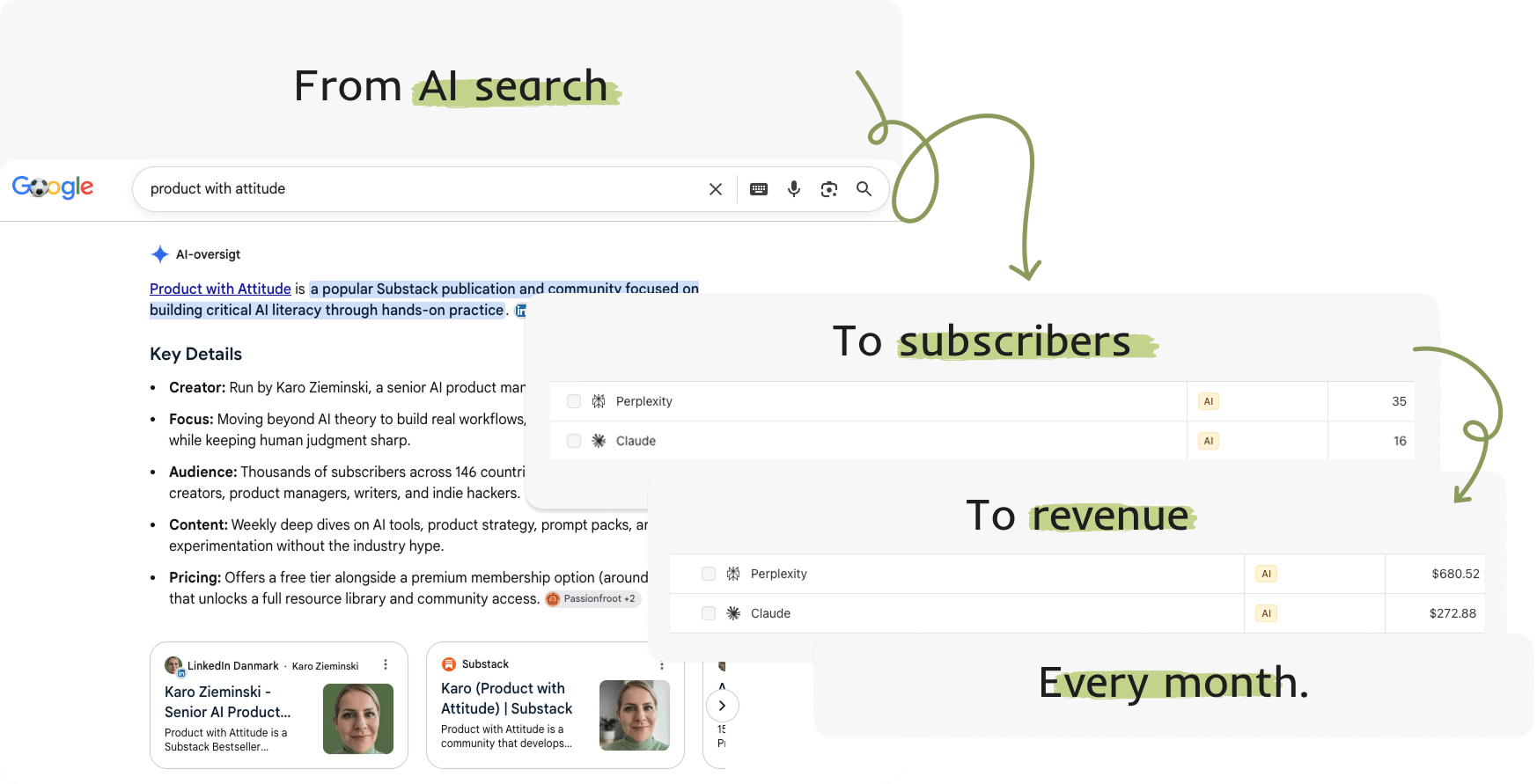
ChatGPT took 7 months to find me.
Claude took 6.
Perplexity: under 3.
When I discovered that Google was citing my work, I had a brief, but glorious, well, look at me moment. And for months, I assumed my llms.txt was to thank for that. I put real work into making it part of my content flow.
And if you have been reading about AI search, you have probably seen this advice:
Add an
llms.txtfile to your website.
If you’re not familiar with this at all, I wrote a simple explainer of what llms.txt is and how it works. In short, it’s a Markdown file that gives AI agents a curated guide to a website.
But the latest research points elsewhere: other parts of my publishing process appear to have mattered much more.
In Substack’s own attribution data, over the past 60 days, Perplexity brought me 35 subscribers and Claude another 16. Some of them decided to become premium members, and together they generated $953.40 in revenue over those 60 days, or about $476.70 per month: roughly $340.26/month attributed to Perplexity and $136.44/month to Claude.
I’m not running a giant media company with an SEO department. I’m figuring this out as I publish, test, and measure. I also got things very wrong on at least one occasion (more on that soon).
But if I can make my work discoverable by AI, you can too.
This is the first in a series. Each next piece will take one part of the process and go much further into the what I do and how I do it.

LLMs.txt Isn't What Got Me Cited
Ahrefs checked 137,210 domains and found 97% of valid llms.txt files got zero requests in May 2026.
SE Ranking ran 300,000 domains through Spearman correlation and XGBoost and found removing llms.txt from the model made it more accurate.
OtterlyAI logged 84 AI bot visits to llms.txt against 62,100+ site-wide over 90 days.
Google’s own guide states we don’t need machine-readable files “as Google Search itself doesn’t use them.”
Don’t give up on llms.txt just yet. I’ll explain how I use it and what it gives me in one of my next posts.
For today, I’m keeping things much simpler: the checklist I use to make my posts and Product with Attitude consistently discoverable and citable by AI.
How to get cited in Google AI Overviews
1. Replace broad keywords with real requests
We use AI search differently from Google.
In Google days, you’d most likely find this article when searching for something like ‘‘best way to get cited’’.
But today, experienced AI users often give the model context and an outcome, not just a short keyword string.
They’ll say something along the lines of:
Here’s my situation, publication, audience, goals and pains. Here’s what I’m trying to achieve. What would you recommend as the best way to be cited by AI?That means the search is more long-tail, rather than keyword-based.
So you want to understand which longer phrases people are asking.
How to come up with search prompts that get you cited
The best way to do that, by far and always, is to look at your own questions.
My own confusion has inspired some of the most popular articles I’ve written for Product with Attitude. I now have a recurring task across my AI tools that sends me every long-tail question I asked that week.
Set it up in a few minutes by copying my Weekly Long-Tail Question Prompt for AI Search Visibility
Alternatively, look at what other people are asking, but focus on the nuance rather than well-established knowledge.
This example is going to be a bit meta, but it’s exactly how I came up with the idea for the article you’re reading right now.
I see more and more people asking ‘‘how to build llms.txt’’.
I know the answer to that question.
But more importantly, I know that maintaining a solid llms.txt takes time. Since the research doesn’t support a correlation with citation frequency, I decided to write about that particular nuance instead. Hopefully it’ll help someone start somewhere the impact can be much bigger, much faster.
2. Give AI something new to find
AI has little reason to cite the internet twice. If it can make the same point perfectly well without you, it probably will.
From my own articles I can see that information gain is rewarded almost every time.
My original experiments, such as my Pangram test, give AI something it can’t find anywhere else. At least not when I publish.
Which also means AI and I happen to value the same thing: evidence produced before the opinion. My core approach is simple: test before tweeting. Otherwise, we’re just writing hype about hype.
3. Have an opinion
Original opinion matters just as much as original information. Perhaps more. Google’s own guidance explicitly recommends original points of view.
I made a related prediction in The Builder-Parent Paradox: writers who publish what they really think will become disproportionately citable.
When AI uses web search to answer a question, finding relevant pages is just one of the steps. From the pile it finds, it assembles the answer we get. Logically, if three hundred pages in that pile say the exact same thing, the model has no particular reason to choose ours.
Also, hasn’t publishing always worked that way?
4. Backlink, backlink, backlink!
Without backlinks, your article is an island.
With backlinks, search engines can map who contributes to a topic, and whose work others consider worth referencing. It’s called the web for a reason.
The more relevant those connections are, the stronger your topical authority.
When writers link to relevant work from others in their field, they’re helping build a semantic map of a topic.
Those connections help search engines understand which publications are shaping the conversation.
- Kathleen Marrero in I Built A Tool Every Substack Writer Needs. And It’s Not AI.
LinkSwap is a tool I built for us, Substack writers, to swap backlinks through trust-based partnerships, in just 3 minutes a week, without the awkward outreach of “hey, would you mind adding my link to your post?”
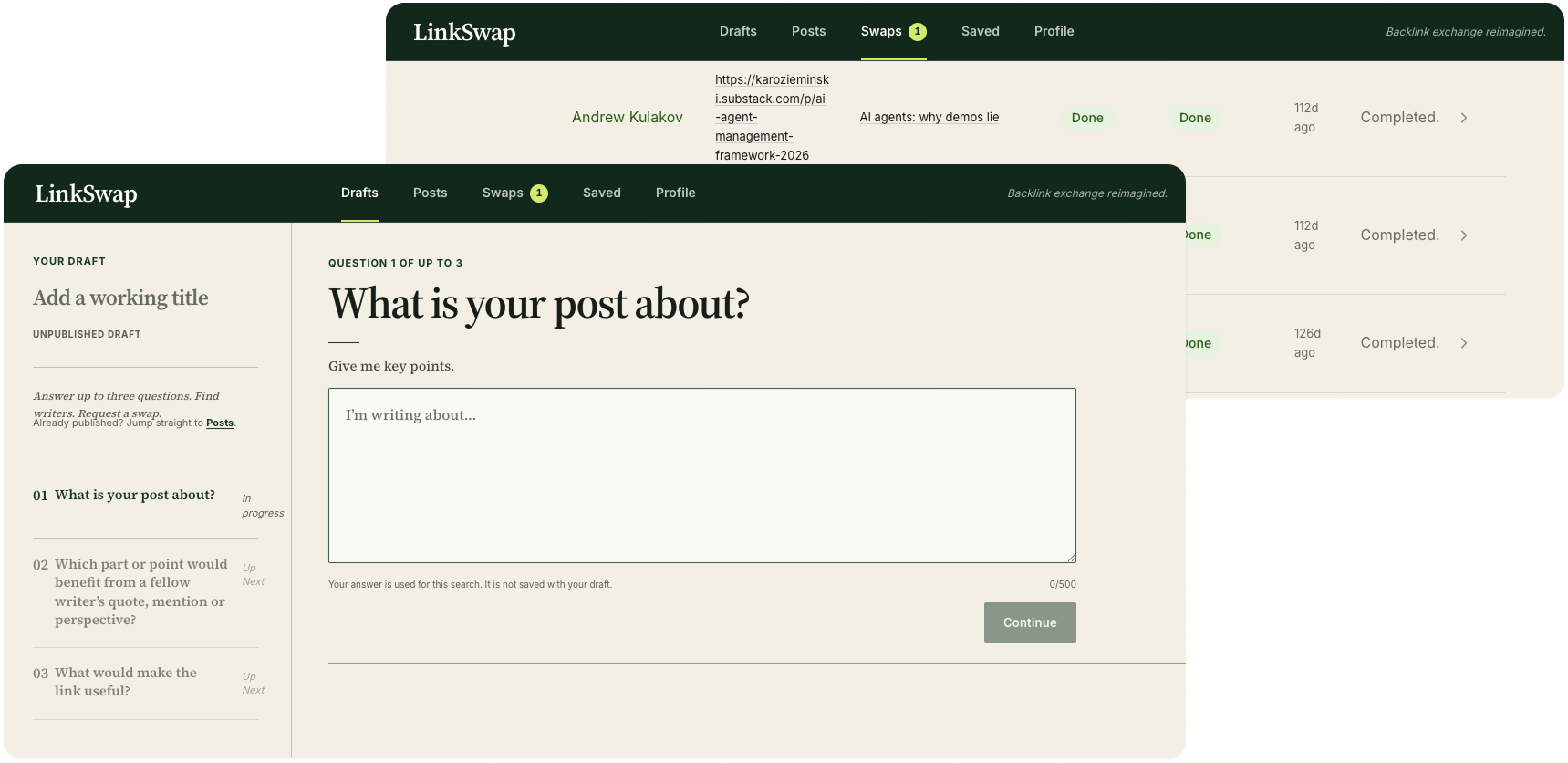
Paid Product with Attitude members get completely free access.
You’re also invited to join our Weekly Skill Swap, another way to earn relevant backlinks to your work.
5. Measure the right thing
I don’t know about you, but Google Search Console overwhelms me every time I open it. (Side note: I’m waiting for someone to build a radically simpler dashboard. If you know that person, send them my way. I will test the hell out of their product.)
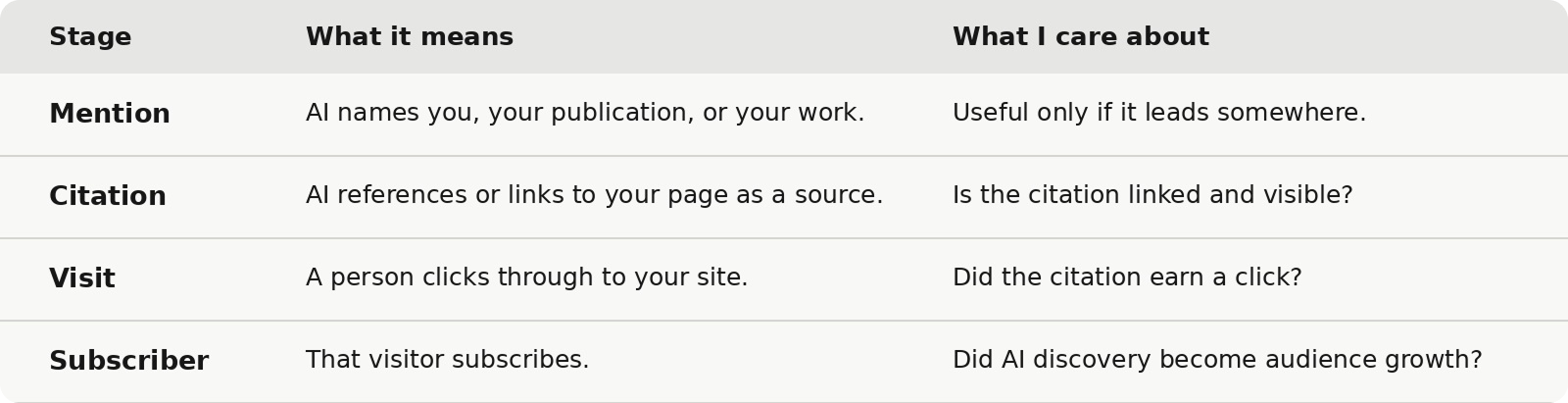
I learned to separate four things that AI-search discussions constantly squash together: a mention, a citation, a visit and a subscriber.
We don’t want a model mentioning us without linking back. (More on that in my next article.)
We don’t want it to cite us without anyone clicking, either.
And we don’t want those clicks to be random.
So this is the formula I care about:
AI mentions × linked-citation rate × click-through rate × visitor-to-subscriber conversion rate = AI-attributed subscribers
And one step further:
AI-attributed subscribers × revenue per subscriber = AI-attributed revenue
If any part of that first formula drops to zero, so does the result.
6. Understand when using AI helps and when it hurts your discoverability
Google is not telling writers to stop using AI. But it is telling us not to mass-produce low-quality content and to remain responsible for what we publish. Which we should do anyway, AI Overviews or not. That’s at the core of the AI-Assisted Craft concept.
Your First Task: The Reason-to-Retrieve Test
Before I publish, I now ask one question:
Does this article contain a fact, result, phrase, framework or opinion an answer engine could only get from me?
If the answer is no, I’m not done.
Keep Reading

I’m Karo Zieminski, AI PM and builder. I write Product with Attitude, an AI newsletter for tens of thousands of readers across 146 countries, helping them develop critical AI literacy the only way it sticks: through practice.
If you want the rest of this series as I publish it, subscribe below.
Very interesting and helpful Karo! I know and do nearly nothing about SEO so this is all very interesting and intriguing. I love the point around make sure you’re saying something an AI won’t find anywhere else.
Karo this is amazing!! I've done a lot of studying from my blog perspective on AI search and this is such an amazing straightforward practical system for it. Thank you for this!! I"m off to share the link with a mastermind group outside of Substack.