

Last verified: September 2, 2026
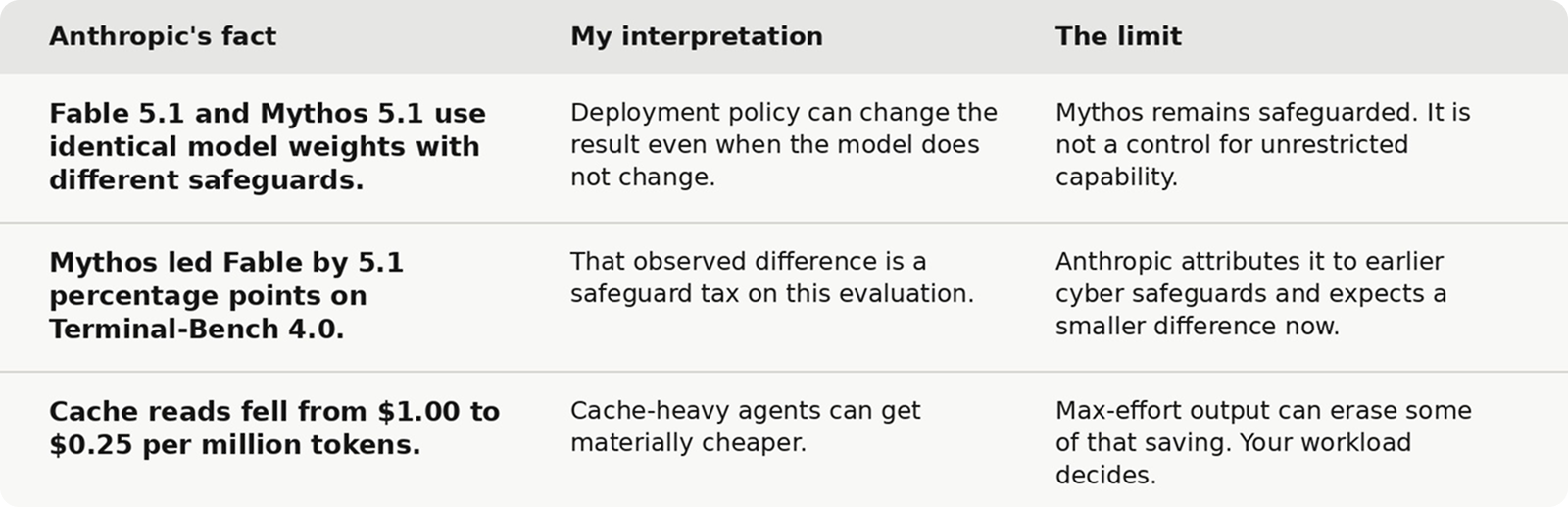
TL;DR: Claude Fable 5.1 launched September 1, 2026, beside the access-gated Claude Mythos 5.1. Anthropic says they use the same underlying model and identical weights, with different safeguard configurations. On Anthropic’s Terminal-Bench 4.0 evaluation, Fable scored 55.8% and Mythos scored 60.9%. The difference was 5.1 percentage points. I use safeguard tax here for that benchmark-specific cost of deployment safeguards intervening in a model’s work. It is a useful number. It is not a universal constant.

Anthropic put two max-effort results beside each other:
Claude Fable 5.1: 55.8%
Claude Mythos 5.1: 60.9%
Difference: 60.9 − 55.8 = 5.1 percentage points
Same underlying model and max-effort setting. Different safeguard configuration.
The safeguard tax is the performance difference observed when deployment safeguards intervene between the same underlying model and the task.
Researchers already use safety tax for capability lost through safety alignment. I mean something narrower: a deployment-layer effect visible in a same-model evaluation.
This is Anthropic’s own point estimate on one 66-task agentic-coding benchmark. The company reports standard errors of ±1.6 to 2.0 points for each model and does not publish a paired confidence interval for the difference. Anthropic says the result reflects tasks where its earlier, less precise cyber safeguards intervened. It expects the difference to be much smaller after the safeguard changes shipped with 5.1. Mythos also retains safeguards, so 60.9% is not a clean reading of some mythical unrestricted model.
The number gives AI product teams a better question than “Which model topped the chart?” Ask where policy intervention changes task completion, latency, fallback behavior, and cost in your own product.

Hey, I’m Karo Zieminski. I build AI products and write Product with Attitude for people who need to decide what to include in their products and what to ignore.
Welcome to the 399 new readers who joined since last week. Here’s what you might have missed:
Share this article with 3 friends or colleagues,
I’ll thank you with 3 months of a premium subscription.
Claude Fable 5.1 and Mythos 5.1: What Shipped
Anthropic released two configurations of one model. Its system card says the weights are identical. Fable 5.1 is available to all Claude API customers and on paid Claude plans.
Mythos 5.1 applies more permissive safeguards for vetted cyberdefenders and life-sciences professionals through Anthropic’s Cyber Verification Program and Life Sciences Verification Program. At launch, access is limited to selected U.S. organizations.
The shared technical envelope is large: a 1-million-token context window, 128K maximum output, and always-on adaptive thinking. You steer reasoning depth with the effort control. You cannot disable thinking. The Claude API model ID is claude-fable-5-1.
Standard API pricing remains $10 per million input tokens and $50 per million output tokens. Cache reads fell 75%, from $1.00 to $0.25 per million tokens. Anthropic estimates that the new model costs around 25% less on typical workloads and up to around 45% less on complex coding and highly agentic work. Those are estimates from Anthropic’s default-effort analysis of four weeks of August 2026 usage, rather than a price cut that every workload inherits. Anthropic’s pricing page has the full cache-write, long-context, regional, and batch rates.
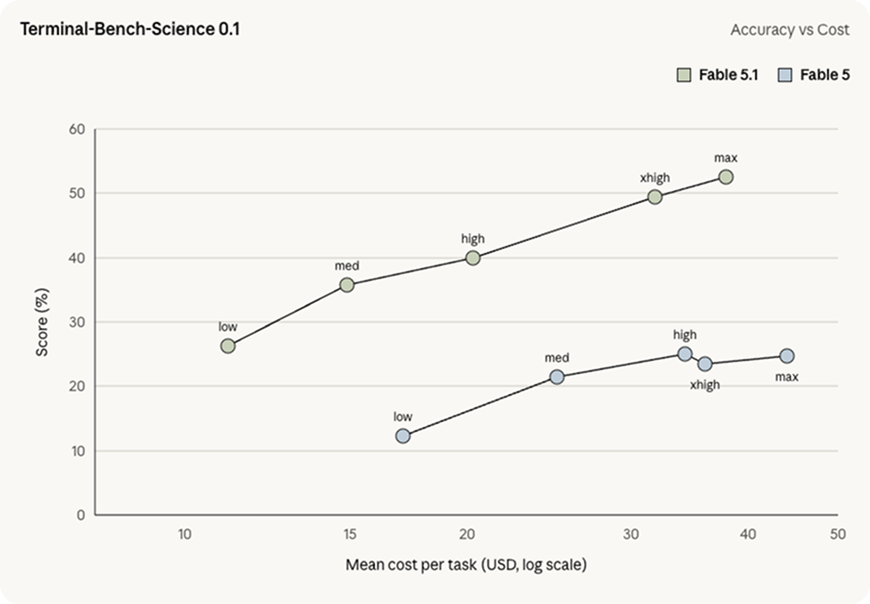
On Terminal-Bench-Science 0.1, Anthropic reports 52.6% for Fable 5.1, versus 24.7% for Fable 5, 29.0% for Opus 5, and 22.4% for GPT-5.6 Sol. That is a dramatic result on one scientific-research evaluation. Anthropic also reports standard errors of roughly 3.5 to 4.5 points, so the broad improvement deserves more confidence than the precise rank order.
Fable 5.1 is available through the Claude API, Amazon Bedrock, Claude Platform on AWS, Google Cloud, and Microsoft Foundry. Its reliable-knowledge and training-data cutoffs are June 2026. Anthropic lists tentative retirement no sooner than September 1, 2027 on Anthropic-operated platforms. Partner platforms set their own schedules.
One enterprise footnote belongs above the fold: Fable 5.1 and Mythos 5.1 require 30-day data retention by default. Anthropic says zero-data-retention customers need express authorization for access. If your procurement team treats retention as a hard boundary, the benchmark discussion can wait.
What the Claude Fable 5.1 Safeguard Tax Measures
The Terminal-Bench 4.0 result was run at max effort for both configurations. Mythos did not “try harder.” Fable’s cyber-safeguard system intervened on some tasks. Anthropic says those interventions sometimes produced a zero score or triggered fallback to an Opus model.
The spread also moves with effort. Anthropic’s system card shows Mythos ahead by 1.5 points at low, 3.3 at medium, 7.7 at high, 8.4 at xhigh, and 5.1 at max. The safeguard tax behaves like a curve across one evaluation, not a fixed surcharge.
This distinction matters because a benchmark score can blend several failures:
The model could not solve the task.
A safeguard interrupted a task the model might have solved.
A fallback model attempted the task and failed.
The evaluation counted an intervention as zero.
A single percentage cannot separate those mechanisms. The paired deployment makes one of them visible enough to investigate. That is the useful part.
A safeguard tax can be worth paying. A system that prevents credible exploit development should lose some freedom by design. The product problem appears when a blunt classifier charges the same tax to legitimate vulnerability research, ordinary health education, or harmless tool use. The goal is not zero safeguards. The goal is fewer false positives at the same safety boundary.
Anthropic says Fable 5.1 moves in that direction. It also says the 5.1-point Terminal-Bench difference came from older safeguards and should be smaller with the release now in production. Treat 5.1 as a disclosed historical measurement, then run the paired evaluation your own product needs.
Claude Fable 5.1 Pricing: Low Effort Needs an Eval
Anthropic’s capability-first model guide says to start with Opus 5 and move to Fable 5.1 when Opus at xhigh or max still misses on demanding reasoning or long-horizon agentic work. That’s a strange thing for a company to say about its own flagship. It is also the most useful sentence in the release.
The cost story gets less tidy at maximum effort. Artificial Analysis reports that Fable 5.1 scored 66 on its Intelligence Index at max effort, versus 62 for Fable 5. It cost $3.76 per Intelligence Index task, compared with $3.14 for Fable 5, and generated roughly 1.7 times as many output tokens. At xhigh, Fable 5.1 scored 65 for $2.72. One point of score cost another $1.04 per task in that setup.
This is a counterexample to a universal saving, rather than a contradiction of Anthropic’s qualified estimate. The evaluations use different workloads, effort levels, cache profiles, and fallback behavior. Artificial Analysis says roughly 4% of Fable 5.1’s output tokens in its run came from fallback models. The clean conclusion is also the unromantic engineering conclusion: compare cost per successful task on your own traffic.
Anthropic’s docs give two sensible starting points for two different jobs. Its prompting guide says to establish a baseline at the default high, then sweep every effort level. Its cost-optimization guide says most agent workloads can start at low and raise effort where the model misses. Low also searches and retrieves less often, which makes the second pattern risky when fresh external information drives quality.
Lance Martin’s launch-day CursorBench result is the useful provocation: Fable 5.1 at low effort matched Fable 5 at high effort on his evaluation at roughly one-third of the cost. Treat that as a prompt to test, rather than a configuration to paste into production.
Per-message effort control makes the sweep practical. Behind the mid-conversation-output-config-2026-07-01 beta header, you can change effort between turns without invalidating the prompt cache. For a first baseline, start at high and step down until a task-specific metric breaks. For checkable agent work, start at low and rerun failures at high. Spend the extra reasoning only where the failure curve earns it.
What Breaks When You Migrate from Fable 5
Three API changes deserve a pre-deploy test. Two return explicit errors under the documented conditions. One can discard state silently.
1. Forced tool use returns a 400
Setting tool_choice to “any” or to a named tool now returns a 400 invalid_request_error. Use tool_choice: {”type”: “auto”} with strict tool schemas, and tell Claude explicitly when a tool call is required. Strict mode validates arguments when a tool is called; it does not force the call. Structured outputs are the better fit when your real requirement is a schema-conformant response.
2. Fable 5.1 thinking blocks are model-bound
Fable 5.1 can read thinking blocks from earlier Claude models. Earlier models cannot read thinking blocks created by Fable 5.1. A router that falls back from Fable 5.1 to an older model can lose those blocks. Without the thinking-binding-controls-2026-08-01 beta header, that loss can happen silently.
3. Editing conversation history can invalidate later thinking
Accounts created on or after August 31, 2026 receive a 400 by default when an edited prefix no longer matches bound thinking. Older accounts may record the mismatch without immediately failing. Dropping the affected block requires the beta header plus prefix_mismatch_behavior: “drop_block”; account age does not select that behavior for you.
The durable migration pattern is append-only history. Use turn-scoped system messages for temporary instructions and Anthropic’s mid-conversation tool controls for tool changes. Then test router fallbacks with real saved conversations, rather than pristine one-turn fixtures.
What Anthropic Loosened, and What It Still Reroutes
Anthropic says Claude Code users can expect, on average, around 60% fewer cyber-safeguard interventions per session than under Fable 5’s previous safeguards. Fable 5.1 now permits vulnerability discovery in source code at general access. Penetration testing, exploit generation, and binary-based vulnerability scanning continue to route to Opus models.
In biology, Anthropic says its current safeguards fire 85% less often on benign elementary-biology and medical requests than the safeguards that launched with Fable 5. Everyday educational and health questions should hit fewer false positives. Life-sciences R&D requests still route to Opus. Both figures come from Anthropic’s release analysis, so they need independent production evidence next.
Mythos 5.1 gives vetted cyberdefenders and life-sciences professionals a more permissive route through the Cyber Verification Program and Life Sciences Verification Program. Project Glasswing was Anthropic’s earlier defensive-cyber initiative around Mythos Preview. The current 5.1 access routes have their own names.
This is the safeguard tax as a product problem. Fable should interrupt less legitimate work while continuing to reroute dual-use categories where defensive and offensive applications are difficult to separate. The interesting number six months from now will be the false-positive rate inside actual customer workflows.
The Watermark Is Provenance, Not Proof of Authorship

Fable 5.1 and Mythos 5.1 apply Anthropic’s statistical text watermark to generated prose. Anthropic says the watermark adds no tokens and produced no practical quality loss in its tests. Detection remains probabilistic. It is weak on short passages, factual text, code, and light proofreading, and a complete rewrite can remove it.
That signal can indicate that Claude was likely involved. It cannot establish who authored or owns the work, and it cannot reliably distinguish Claude writing from heavy Claude editing. It is provenance evidence with a limp, not an indelible confession.
My 159,002-Word Pangram experiment on found the same category error from another direction: detector confidence and authorship are different claims.
For supported generated files, Anthropic names PNG, JPG, and SVG as examples. Claude can attach a cryptographically signed C2PA Content Credential recording that Claude made or processed the file. Anthropic says it introduced these measures in response to Article 50 of the EU AI Act through the voluntary Code of Practice on Transparency of AI-generated Content, which it signed. Article 50’s marking and detection duties took effect August 2, 2026. Existing systems received until December 2, 2026 for that specific duty.
When to Use Claude Fable 5.1
Start with Opus 5. Anthropic recommends it, and I have no reason to argue with a company talking itself out of an upsell.
Reach for Fable 5.1 for demanding reasoning, long-horizon agentic coding, multistep research, or document and spreadsheet work where small mistakes compound across many actions. Anthropic also recommends it when Opus 5 at xhigh or max still fails your evaluation. Skip the upgrade when Sonnet 5, Haiku 4.5, or Opus 5 already clears the bar at lower cost.
Before switching, answer five questions:
What task-specific evaluation is the cheaper model failing?
Does Fable 5.1 pass the same evaluation at high, medium, or low effort?
What is the total cost per successful task after output tokens, cache reuse, and fallback calls?
Does low effort reduce search or retrieval enough to hurt the result?
Can the integration survive forced-tool, thinking-block, prefix-edit, and retention changes?
Stop when the cheapest configuration clears the quality threshold with an acceptable failure rate. A leaderboard cannot choose that threshold for you. If you’re comparing whole products rather than API models, my ChatGPT Work vs Claude Cowork vs Perplexity Computer analysis covers the surrounding tools and constraints.
Frequently Asked Questions
What is Claude Fable 5.1?
Claude Fable 5.1 is Anthropic’s most capable widely released model as of September 2, 2026. It is built for demanding reasoning, long-horizon agentic coding, multistep research, and complex knowledge work. It has a 1-million-token context window, a 128K-token maximum output, and always-on adaptive thinking controlled through effort settings. Its model ID on the Claude API is claude-fable-5-1. Fable 5.1 shares identical model weights with Mythos 5.1, according to Anthropic’s system card.
What is the Claude Fable 5.1 safeguard tax?
The safeguard tax is the benchmark-specific performance difference observed when deployment safeguards intervene between the same underlying model and a task. On Anthropic’s Terminal-Bench 4.0 evaluation, Fable 5.1 scored 55.8% and Mythos 5.1 scored 60.9%, a difference of 5.1 percentage points. That result does not show a universal 5.1-point cost. Anthropic attributes it to earlier cyber safeguards and expects the current difference to be smaller after its 5.1 safeguard changes.
What is the difference between Fable 5.1 and Mythos 5.1?
Claude Fable 5.1 and Mythos 5.1 use identical model weights with different safeguard configurations. Fable is broadly available through the Claude API and paid Claude plans. Mythos uses more permissive safeguards for vetted cyberdefenders and life-sciences professionals through Anthropic’s trusted-access programs. Mythos still has safeguards; it is not an unrestricted edition. At launch, access is limited to selected U.S. organizations.
How much does Claude Fable 5.1 cost?
Claude Fable 5.1 costs $10 per million input tokens and $50 per million output tokens, unchanged from Fable 5. Cache reads dropped 75%, from $1.00 to $0.25 per million tokens. That is where the real savings live when a workload reuses context heavily.
Those are Anthropic’s standard API rates. Long-context requests, U.S.-only inference, batch processing, and partner platforms can change the bill. Measure cost per successful task at each effort setting; max effort generated enough extra output in Artificial Analysis’s test to make Fable 5.1 more expensive than Fable 5 on that evaluation.
What breaks when migrating from Fable 5?
Three behaviors need tests before migration. Forced tool_choice values now return a 400. Earlier models cannot read Fable 5.1 thinking blocks, so router fallbacks can discard state. Editing an earlier turn can invalidate every bound thinking block after it, with account and beta settings determining whether you get an error, a recorded mismatch, or an explicit drop. Build append-only conversations and run your saved production traces through the new model before changing the default.
Is Claude Fable 5.1 included with Claude Pro or Max?
Fable 5.1 is available on every paid Claude plan. On Pro and standard Team seats, it uses pay-as-you-go credits from the first request. Max and premium Team seats include Fable usage up to 50% of the shared weekly limit across Fable 5 and 5.1. After that, you can use credits or switch models. Anthropic’s plan guide has the current entitlement details.
Keep Reading

Subscribe for the product-focused take on model announcements: what changed, what might break, and whether the upgrade belongs in your product.