


TL;DR: Anthropic released Claude Fable 5.1 and Claude Mythos 5.1 on September 1, 2026: one underlying model with two safeguard regimes. Fable 5.1 cuts cache-read pricing by 75%, to $0.25 per million tokens, but maximum-effort workloads can still cost more because the model produces more tokens. Anthropic also tied thinking blocks to the conversation that produced them for new API accounts created after August 31, an anti-distillation measure. I ran 136 Chinese-language queries alongside my English-language sweep. The two searches surfaced different launches: English coverage led with cost and the 212-page system card. Chinese coverage led with 反蒸馏 (anti-distillation), 中转 (relay) pricing in RMB, and comparisons with Kimi K3, GLM-5.3, and DeepSeek rather than GPT-5.6 Sol.

My newest obsession is comparing how AI is discussed in the two countries shaping its frontier: the US and China.
I want to see what happens when you place the coverage side by side, for three reasons.
First, a model release may be a technical event, but the coverage around it is often cultural. It shows what each country celebrates and fears.
Second, this experiment has made me appreciate my years at Xiamen University all over again.
Third, we gave AI the ability to translate the world, so let’s not use it to only read English.
Today, I’ll show you how the same Fable 5.1 release became two different stories.
I’m Karo Zieminski, AI PM and builder. I write Product with Attitude, an AI newsletter for tens of thousands of readers across 146 countries, helping them develop critical AI literacy the only way it sticks: through practice.
Welcome to the 399 new readers who joined since last week. Here’s what you might have missed:
Claude Fable 5.1: Pricing, Benchmarks, and the Safeguard Tax
Claude Cowork Guide for Power Users: 50+ Tested Tips on Plugins, Skills, Sub-Agents, and Memory

The Same Launch, Read in Two Languages
Research method: Between September 1 and 3, 2026, I ran 136 Chinese-language queries alongside an English-language sweep across Perplexity, Baidu, Google Search, and ChatGPT. The queries covered release information and benchmarks, pricing and cost, access and availability, anti-distillation and safeguards, comparisons with Chinese models, and the relay and account market. This is a comparison of the coverage my searches surfaced. It shows editorial framing, not a national state of mind.
The short version:
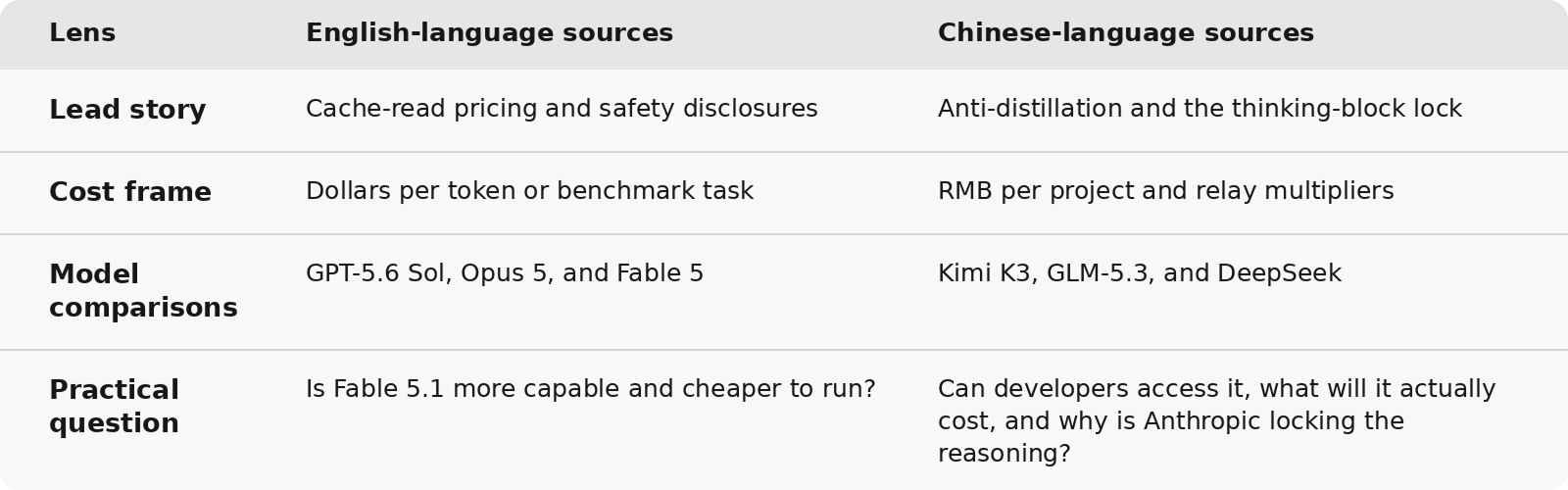
Both language spheres had the same 212-page system card. They picked different lead stories from it. In a way, the split is predictable.
English coverage on day one converged on two things. The cost cut, and the safety disclosures. VentureBeat focused on a 75% cost reduction for cache reads and daily.dev on a system card.
Chinese coverage led somewhere else.
TMTPost (钛媒体) was the first source I found that added anti-distillation to the headline, calling it a ‘‘lock’’.
Original: Anthropic发新模型,头条不该是跑分,该是一把「锁
Translation: Anthropic ships a new model; the headline shouldn’t be the benchmark scores, it should be a lock.
— TMT
QbitAI (量子位) led with eight benchmark wins and a cost reduction of up to 45%, then covered the new anti-distillation mechanism in the article:
Original: 8项屠榜,最高降价45%,反蒸馏机制上线
Translation: Fable 5.1 tops eight leaderboards, up to 45% cheaper, anti-distillation mechanism goes live.
— QbitAI
EE Times China (电子工程专辑) skipped the benchmarks entirely and went with "竟然有反蒸馏机制?看不起谁呢", roughly: ‘‘An anti-distillation mechanism, seriously? Who exactly are you looking down on?’’
Share this article with 3 friends or colleagues,
I’ll thank you with 3 months of a premium subscription.
What Chinese Developers Are Priced Against
English comparisons ran Fable 5.1 against GPT-5.6 Sol and Opus 5, because that’s the table Anthropic published. Chinese comparisons used a different set. The models their readers can buy.